Blog post

Time Ariel Marrero

With all the modules and due dates time is such a huge matter. I honestly know first hand that in order to do well in all the modules staying on task and doing what your supposed to do helps and is worth the time. Slacking off and not doing work really effects how my work comes out. I also learned that every minute counts and ive experienced that time is such a big thing that i cannot afford to loose out on. Overall dont waste any time and EVERY minute counts.

Bio Med and Augmented Reality

By: Darby Buscemi

Let’s be honest here. I hate dead things. Just the fact that something that used to be happy and alive and breathing is now dead and lifeless freaks me out. Another thing that freaks me out. Blood. I can’t stand it. When I see blood I either want to cry or pass out. So deciding to do the Biomed module was not something that I was looking forward. I had wished that I could try to avoid it all together. That wish did not come true.

After learning that the module will not involve any dissections, dead things, blood or gore, I had warmed up a bit to the idea of the Biomed module. After the interview of a student in the Biomed pathway for challenge one, my group and I got ready to start challenge two. We were told to create a poster that showed what we thought medical technology would look like in 50 years time. But there was a catch. This poster would have to include some virtual reality.

First, I know what you’re probably thinking. What on Earth is augmented reality? Well, if you’re like me and you thought it had to do with video games such as the Sims you’re wrong, sorry. Augmented reality is a live direct or indirect view of a physical, real-world environment whose elements are, well, augmented by computer-generated sensory input such as sound, video, graphics, or GPS data. But don’t go and get it confused with virtual reality. Virtual reality is where there’s a computer-simulated environment that can simulate presence in real world places. It would like being in a dream world so to speak.

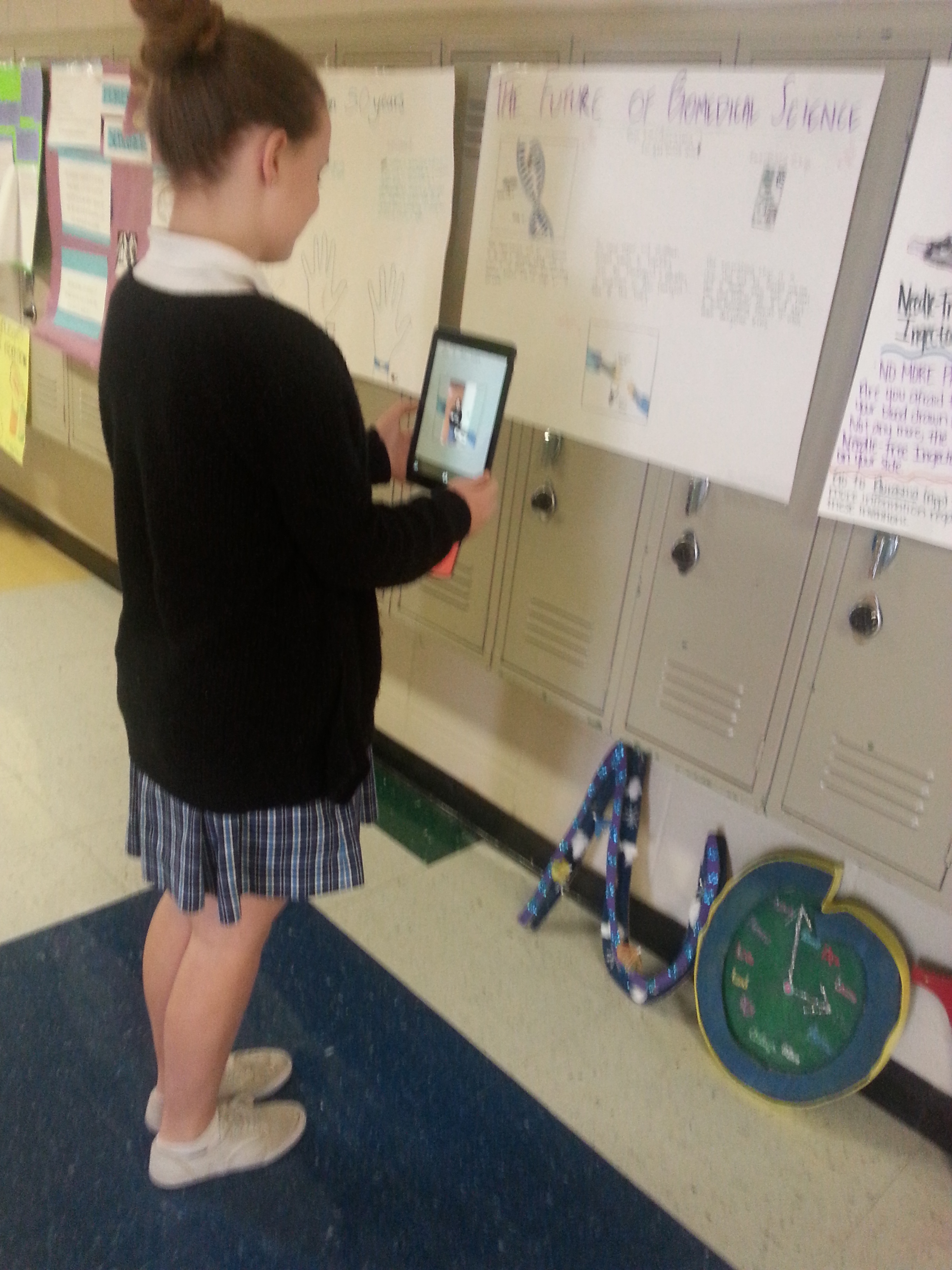
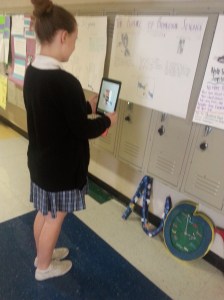
I know this all sounds horribly confusing but it’s actually really simple. We use and app called Aurasma and when you have the program done you should be 20150210_092729able to scan an image with the app and the image/video that is programmed with the thing you scanned should show up on the screen of the app. It’s actually really simple.

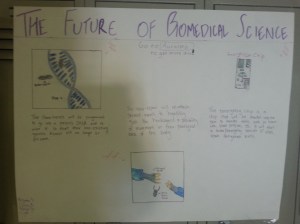
After two days of brainstorming ideas, we finally came up with three ideas. The Nano-Gene20150210_092711s, a way to help cure genetic diseases, the Nerve Repair, a way to help people with severed nerves regain feeling, and The Emergency Chip, a chip that can monitor vitals such as heart rate and blood pressure and it will notify emergency services if these vitals reach dangerous levels. After we had our poster finished we had to figure out what we wanted the virtual reality part to be.

We decided on m20150210_092721aking the virtual reality part a brief description of what we had shown on the poster. So after the filming all we had to do was upload the videos onto the app and make it so that whenever you scan the poster, the video with the description shows up. Overall, I’m really proud of this project and how it came20150206_100013 out. I also had a lot of fun.20150210_092654
Mechanisms- Lily Bedford

By: Lily Bedford                                                                                             In our second module we created an egg beating mechanism. We created this mechanism with by following this design Brief;

         
Client: Top Chef

Problem Statement: create an egg-beating mechanism

Design Statement: create a mechanism using 90% vex component

Constraints: 90% vex components, creative, function, uses gears.

Our project ended up combining Raymya and my ideas. Her idea being resembling a whisk (incorporated through the screws that are the literal whiskers). And mine being hand held with gears turning the whiskers.

My Reflection:I am including my reflection to explain to you, the read my feelings of the outcome, and process of this project.

The big idea of this module was to create a mechanism that could beat eggs for challenge two (making a mechanism for the first letter of your name was part of module one) and to learn the basics of mechanisms. This created an open-mindedness for tinkering, which is basically part of engineering, but on a much larger scale, what i’d considered as my pathway.Tinkering, equivalent to a person skilled in various minor kinds of mechanical work, “jack-of-all trades”. This skill of tinkering could be used as a side job for extra cash, or for making little things that are beneficial to someone’s daily life very much like our egg beater.

Mechanical Systems

Mechanical Systems by Calvinesha

At the beginning of the semester when we came from winter break me and my partner Jacinda worked on the Mechanical Systems module which actually took us 3 weeks to finish.

When we started the Module with a section called mechanism build where we had to pick a mechanism and build it and take a picture. For this we chose the chain drive and the simple gear train. Here is what they looked like. First we had to gather all of the Materials for each section of the simple gear train and Secure it to the point where it was standing up. Then we had to put the pieces together with some kind of plastic thing that helped the gears spin and the we had to get axels to hold the gears on and then we got a handle for us to spin the wheel around. After we finished putting everything together we had to take a picture of it and post it on Haiku. If you are wondering what Haiku is it is our school link where we do our work and turn in some of our assignments.

Into Photography By: Zoe Renteria

Into Photography

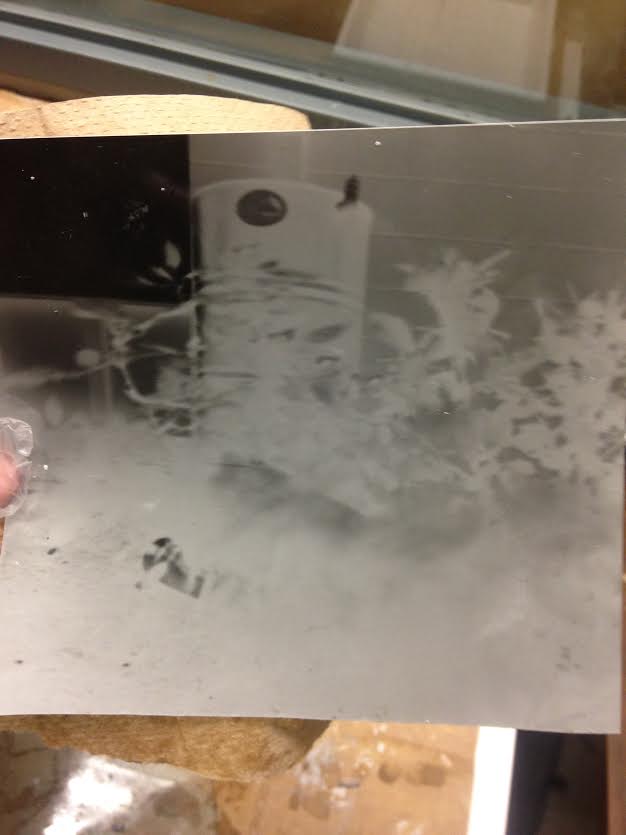
This six weeks I did the Into Photography module. For this module we learned how to make a pinhole camera and how to take a picture with it. The process was a bit challenging because we decided to make a box instead of a tube. Then we had to make sure that there wasn’t light being shown through, which took us a while. We got glued all the sides first, then we went back and taped them all with black electrical tape just incase we had little holes.

Snapping a picture

Now that we had done all of our building it was time to take a picture. Before we could go and snap a picture we needed to prepare the camera with the film. We used Mrs. Sauter’s office and turned it into a dark room which was really cool. This is really where teamwork cane to play, one person had to hold the red light, another to tape the film inside of our box and tape it shut. Snap! My team and I took a picture of some pretty flowers. Once we got back into the classroom, my job was to remove the film and soak in the chemicals that makes it develop. At first we didn’t have anything showing up but with a little patients we got a really great result.

zoe3

Reflection

I think that is was my favorite module to do because it was really fun to create something that actually works. I was really surprised that our camera really worked, I mean believing a cardboard box is going to take a picture is a bit much. I had a lot of fun working wit my team mates throughout this process, I couldn’t have done any of this without them.

PLTW

Project Lead The Way(PLTW) is a class that we take as 8th grades to explore all the pathways to get a peek of what each pathway would be like. The pathways we have here at ARS are Engineering, Bio-med, and Media tech. Next year in 9th grade we take one of the three pathways.

Engineering is one of the three pathways we can take in 9th and thought height school. In PLTW for engineering, the modules we have are materials, computer automated drafting, construction and fabrication, mechanical systems, and computer science. Each module is different from the other modules. Some you may use wood and nails, toothpicks and glue, inventor, tools, gears, laser cutter and little bits. Engineering is all so fun , but we still have two more pathways to get through.

Media tech is also one of the three pathways we can take in high school. For Media tech, the modules we have are blogging, videography, and photography. In each one you are either creating a blog, making a video, or taking photos. Okay, so we gotten through engineering and media tech but we still have bio-med.

Bio-med is also one of the three pathways we can take in high school. For Bio-med, the modules we have are simulation applications in medicine, prosthetic, medical robotics. In each one you are either creating a prosthetic, a simulation demonstrations presentation, or designing a medical robot.

Now we have gotten through all pathways and models that we can do with in those pathways.
~Ora Edwards

Wood Sandwhiches: by Samaria shearrod

So far this semester in Pltw, we have been working a lot on a project corresponding with our science class. The project itself was full of criteria and deadlines, but there was one particular part that had its fair share of challenges. Building a topographic map was a pretty hard thing to do, and finally being done with it felt great.

When mrs. Sauter announced that we would be going back to modules for a little while, I was relieved. Modules are a little more low-key than the major project we had just completed, and it sounded pretty easy. My group and I discussed what modules we were interested in, and we all were pretty set on building a birdhouse.

Little did we know, we had to complete an individual challenge first, known as the “Wood Sandwich” It sounded even easier than the birdhouse, so of course I was excited. Mrs. Sauter taught us how to use pretty much every tool we would need in the makerspace, and then she let us show her what we learned.

The overall sandwich wasn’t that challenging, but when it came time to hammer the nails, I started to re-evaluate my choices. It seemed simple enough, so I just went for it. After less than 45 seconds of hammering to a beat with my group, I hammered my finger and split the wood. I didn’t think that either was possible, so it set me back a little. After two more pieces of wood and three bent nails, mrs. Sauter decided to cut us all a little break so that we could move on.

Though the nail never actually made it through the wood, I experienced the same hard work and pain that went with it. After this experience, I learned not to underestimate any module, because even though some may seem like a piece of cake, all of them have their own challenging components.

Why so serious? #TheJoker

By: Yenifer De Lara Gutierrez (A3)

It doesn’t matter what I do in PLTW class, I always have fun. It’s a pretty chill class, even with deadlines. Having fun and learning at the same time is exactly what teachers want. Learning is good. But having fun and learning is great. (And I do know that everyone has their own different idea of ‘fun’ & ‘learning’… I don’t expect everyone to agree with me.)

When you have fun, everything’s better. You smile. You laugh. Live. Love. Learn. By smiling and having fun you realize just how not so bad PLTW work is. Even if the fun & games has nothing to do with PLTW, its okay, just as long as you stay on task and complete work.

You have to take a break sometimes. Its just too much. You get frustrated with the module you’re doing. You worry about creating perfection, or, you at least try to reach for it. But, I mean, in the end, the story behind it or the process/journey is what matters most.

You goof off just little and eventually return the chaotic reality… Or somehow you can balance the amount of fun and educational learning you have/want.

Classes and school in general shouldn’t be just work-work and work. Nothing else. No. No. No. No. There’s always time and space for fun. My friends and I point out mistakes and faults and laugh. Wether its a speech impediment, misspelling or bad cut, line, trace, paint job, click, word, move, haircut, and so on so forth…

Remember; Live. Love. Learn.

Building a bird house!

By Lucero Martinez

It’s not very difficult if you really want to build a birdhouse this is what you have to do. First of all you have to know what tools you’re using and how to use them. You have to watch the videos to show you how to use some of the tools and when you finish watching them and you decide to practice how to use the tools always be safe if you’re under 18 years old always have an adult supervision. Next you are going to be making a wood sandwich the purpose of this is to help you learn what kind of screws you’re using and how to screw them.

Now the next step is for you to start thinking on how you want you’re birdhouse to look like, when you have an idea of what you want it to look like start designing it but don’t forget to put what measurements you’re using. When you’re done designing find wood and start making your measurements and then you will use the miner saw so you can cut your wood. When you’re finished with that grab some wood glue and start putting your wood pieces together and remember try to put them as 90 degree angles. Then let it dry. When it’s dry you will learn how to use the nail gun so it can help your birdhouse be more secured.

When you’re done with everything you will be able to decorate your birdhouse as you choose. You can use paint and use different colors as me and my group did or you can also just choose a single color, it’s your choice. Then let your birdhouse dry and then you will add and eye screw so you can hang it up anywhere you would like and thats it you’re done, hope you have fun!

About PLTW & Maker Fair

Getting To Know PLTW & Maker Fair

PLTW, also known as the ARS Makerspace, is a class where we focus on technology and innovating inventions through modules. A module is a basic lesson that helps us by learning new things about the three pathways offered at Ann Richards and we take that knowledge a step further by coming together with ideas to innovate an object that could be helpful to our community.

Some reasons we do modules, is not only to let our knowledge grow, but also to get us experienced with the work the three pathways (which are Engineering, Media Technology, and Biomedical Science) require. Working on modules is also very beneficial because it gets us ready for high school and writing a reflection after every module, we have to make a decision over our experiences. Those decisions were already made of us choosing the Pathway that interests is more and I chose Biomedical Science.
Some modules we have in the Engineering pathway are Mechanical Systems, Computer Automated Drafting, Construction & Fabrication Basics, and Computer Science. In Media Technology we have modules like Blogging, Videography, and Intro to Photography. In Biomedical Science we have Stimulation Applications in Medicine, Prosthetics, and Medical Robotics. These are all great options that help us gain more knowledge as a designer so we can create a better future in technology to help out our community.

My experience with these modules has been actually very good. I have done a couple modules which are The Design Process, which was the first module everybody had to do at the same time and what we did was that we created a phone speaker. I have had more experience on the Media Technology Pathway and have done Blogging, Photography, Screen Printing, and Videography with my different groups. I really like Media Tech and I think it is pretty easy. I have also worked a little on Engineering with modules like Mechanical Systems and currently working on Automation and Robotics to start getting ready for the Maker Fair. Even if I am currently working on this module, I am working on planning what my teammates and I will do for the Maker Fair and on getting the application done. I’m honestly really excited for the Maker Fair and to just be able to show our innovation.
By: Crystal R.