Ann Richards Girls Visit Indianapolis For PLTW Summit

By Helen Foster

From this past Sunday to Wednesday, a few of our Ann Richards girls had the amazing opportunity to attend the national PLTW summit in Indianapolis. We have been learning about PLTW and the many ways we can apply it this semester, so I thought it would be cool to learn more about this summit and what it’s all about, as well as what our girls’ role was there. I decided to use my connections to get an interview with one of the attendees, Emma Foster, an 11th grader and engineering student. Last year, she and her engineering classmates redesigned an airstream trailer by gutting it and turning it into a functional, Eco-friendly teacher’s lounge.

What was the summit for?

The PLTW summit was created to gather together teachers, school administrators, universities, and corporations dedicated to STEM education. Participants met with PLTW students involved with innovative PLTW programs, learned from PLTW partners, and engaged in professional development.

Who created it?

I’m not quite sure who created it… maybe Vince Bertram (CEO)

Why does it meet in Indianapolis?

The PLTW Headquarters are in Indianapolis, and the JW Marriott Indianapolis has a huge conference center.

What did you do during your time there?

We saw several amazing guest speakers, presented our PLTW program to the over 1,300 attendees, attended a few breakout sessions about the various aspects of PLTW, chatted with teachers and administrators, and explored Indianapolis a bit.

What did you present about?

On the big stage, we presented about Project Ventura and the maker movement we’re starting at our school. At the smaller breakout session, we talked more about our schools’ PLTW program and how to get girls engaged in STEM education and the challenges associated with that.

Did you meet anyone interesting while there?

We met the CEO of PLTW, Vince Bertram and got to talk to him at length. We also got to meet a few PLTW students from around the country, since 4 other high schools were invited. We also met the dean of Missouri S&T and various industry and university professionals.

How do you think others felt about you and the other Ann Richards girls?

We felt kind of like celebrities! After our main stage presentation, people would come up to us and ask “are you the airstream people?” and talk to us about our personal experience with that.

What did you learn about PLTW and it’s community?

I learned that there are a LOT of passionate people dedicated to helping students succeed in STEM education, and also how important PLTW is to closing the education gap and helping the economy as a whole.

The next of these summits takes place in 2016, so if you want to, make it your goal to attend. It’s not an opportunity worth missing. For more information, visit https://www.pltw.org/pltwsummit

The Toothpick Bridge Experience By Jacky Ortega

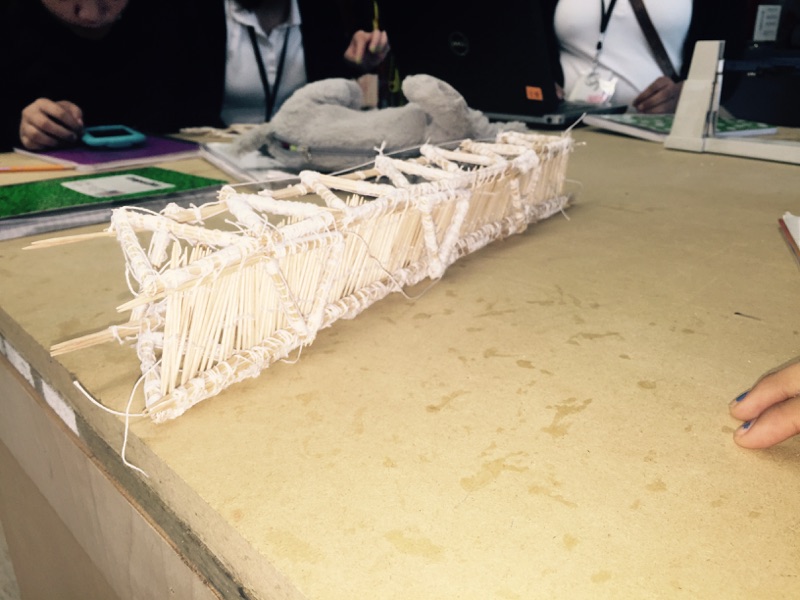
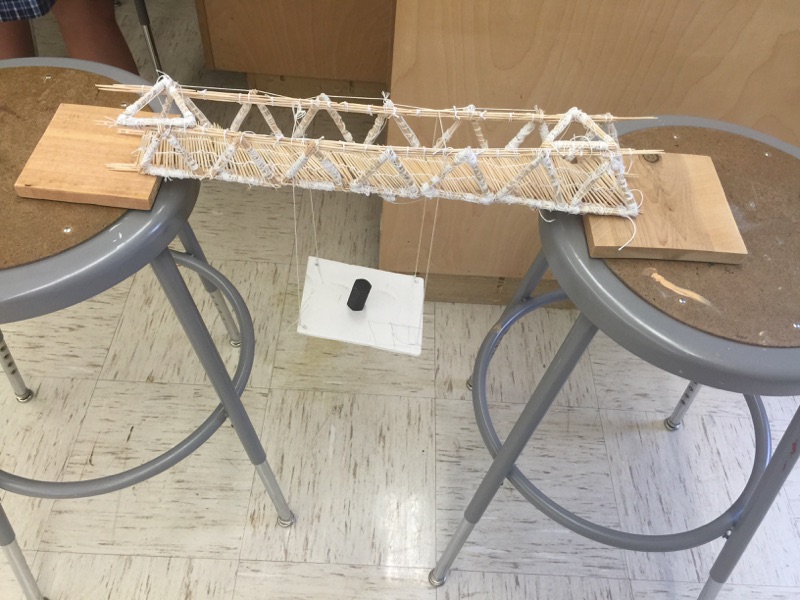
The struggle is real!!!!! Building a bridge using only 3 materials, toothpicks, glue and string. This project was a nightmare, coming up with a way to make a successful bridge using only these materials. I mean I know we had to be creative and think out of the box, but when pressure hit me the only thing in my brain at that time was smoke. I found out that when it comes to building a bridge don’t sign me up because I cannot make it through that experience again.

It wasn’t the building process that got me, it was the part where we had to be creative and patient on getting it done. When I saw that the bridge wasn’t gonna be built overnight and we had to be patient on it for it to get dried. I got so impatient and I just wanted to break the whole bridge. After building the bridge I honestly learned so many things after building this, I learned to take my time yet use all the time that I have wisely because that “time” that you have doesn’t always last for a very long time. I also learned that you should plan ahead because for me only having a glue and string to put the toothpicks together was really difficult and we needed to be creative on the way we joined them together.

Although I struggled to get this bridge done and “perfect” I did learn a few things that might help me get through life and although my bridge didn’t get finished I had fun building it and going through this hard experience!

Working in a Group Isn’t That Easy

Working in a Group isn’t That Easy
by: Tori B.

Participating in STEM based class is something you are required to do, whether you like it or not. But, all of us Ann Richards girls love to do so. I mean, when you tell us something new and interesting, you’ll definitely be drowning in questions.
When your teacher assigns you a seat nowhere near your best friend, you might feel a tiny bit closed off. In our PLTW class, we do modules with a group. Now, the process of completing a module has many steps. You go through the process of picking your module from either the Bio-medical, Media Tech, or Engineering Pathway. Then, you brainstorm, complete challenges, and create the final product together. Since there is an amount of diversity in your group, you will have different ideas. This is where the contributions and discussions fall in place.

Speaking your ideas out loud

While completing a group project, your own opinions and ideas matter. You need to learn from others and make sure they learn from you as well. You have to listen, question, and respond. But most importantly, you need to speak your mind. If there is a question swimming in the back of your head from last weeks discussion, you gotta take care of that.
In my PLTW class we brainstorm tons. My group doesn’t leave one person’s contributions out of the plan ever. We make sure everyone is heard. I mean, once we had one idea of little tiny robots walking into your ear and acting as little doctors inside your body. So then we wrote it down (even though we knew it would be impossible to do at this day and age).

Contribute, Contribute, Contribute!

This is the most important part of all. Your group is basically a team, and if one of you slacks off, everything will be harder for everyone else. This means that everyone should contribute equally and appropriately. When my group brainstorms, we do the blurt out method (it doesn’t sound as good as it works). We just blurt out any idea we have (that’s how we got the tiny robot idea).
In our class we have different “Challenges” or assignments to complete together by a certain date. We have to make sure to help each other out and get as much of our parts done. So when we’re done with our project, we all can take full credit.

Augustus Waters more like Augmented Waters

By Khammila S.

What is augmented reality? Augmented reality is a indirect, or direct view of a real-world environment created by animations, sounds, or videos. An example of augmented reality, is the Sims Game where you can live a close to real-life simulation.aurasma
In our PLTW (Project Lead The Way) class, we are encouraged to experimentt with technology and engineering thus, we were introduced to Aurasma. Aurasma is an interactive app (which is free) that can help make sharing information more efficient. To use Aurasma, you just take a picture of what you want to be scanned and then add a link, video or animation, and when the person scans it using the app, they will get that information.
When using this app, I was surprised at how easy it was to use and how the animations really popped out as if it actually came out of real life. It then occurred to me how apps were also progressing and becoming more than just games or social media. Aurasma is definitely a great app to use when spreading information or data fast which is basically what our society is all about.
At the rate we are advancing our technology each day, we can assume that in 10-20 years our society will have changed drastically. Apps will probably be out of date, there will be new mobile devices and other crazy inventions that will blow our minds. Augmented reality will be taken to the next level and could be used for education, medical, or social purposes. So get ready for the future and the technology that will come with it!

Journeying Through the Modules

Hello my wonderful fellow readers!!!

My name is Karla Rodriguez, and I am an 8th grader here at the Ann Richards School. As an 8th grader, one of the biggest decision you have to make is choosing which pathway you will take the following year as a 9th grader. Ever since I was a little girl I’ve been fascinated with crafting and building and just that sort of stuff and when I heard that we had to make a choice between Media Tech, Engineering and Bio Med I automatically knew I wanted to take engineering.

The STEM and PLTW classes offered here are an amazing portal that allow us to pursuit what we find interesting ,thanks to our teachers of course. Eighth graders have a class called PLTW and in that class there are modules that we can choose to perform that are based on our future pathways, in my case engineering.

BridgeFor the first engineering module I did, me and my group had to construct a bridge that had to be  made out of only cotton string, toothpicks, and Elmer’s glue. Even though it sounds fairly easy there were actually quite a few complications. The first pieces we attempted to build were accidentally thrown away so we had to start over. Yes, we were upset, but this allowed us to start again and improve our building with the help of our previous mistakes. We eventually finished and our bridge wasn’t the best but it was still good for us.

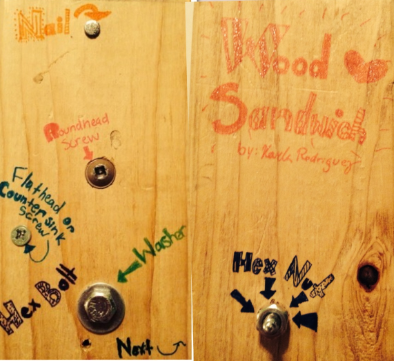
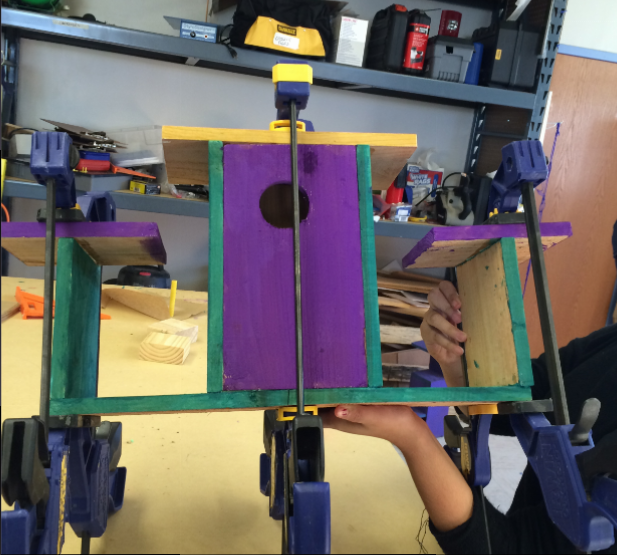
The next module we did was called Construction and Fabrication Basics Wood Sandwichwhich is exactly what it sounds like. We had to assemble a Wood Sandwich (and no, it is not edible) which included sawing, nailing and screwing. There were about two parts which were very difficult to put in; the round head screw and the hex nut. For the round head screw, the drill wouldn’t go through the wood no matter what I did, it took a very long time Birdhousefor that to go in. I was also very stressed on putting the hex nut on. The nut wasn’t really the right size for the bolt, so I had to forcefully tighten it down, which took me a long time because I had to figure how to tighten it.  After we each made one sandwich, we had to create a right angle birdhouse which would benefit the lives of Native Texas birds. I honestly loved making the birdhouse because 1) I learned how to build a birdhouse, and 2) I was able to actually use power tools which is very cool.

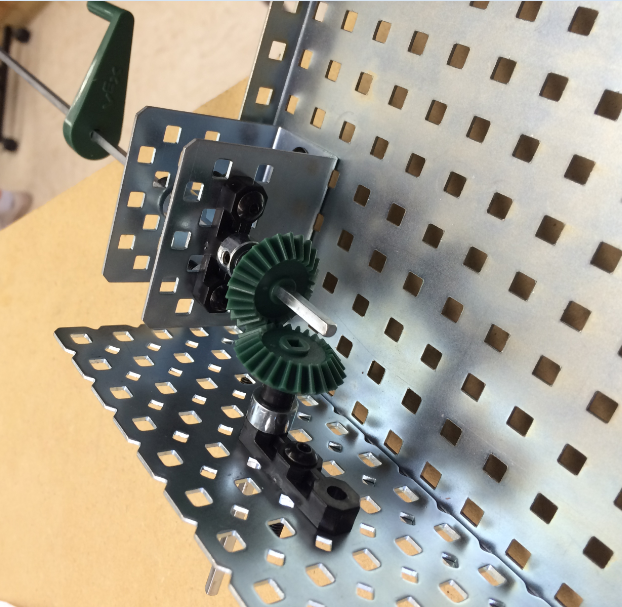
Mechanical Systems is the module I am currently working on with my group at the momBevel Gearent. We have to put together certain gears according to our last names. We aren’t finished yet but so far we have completed putting the bevel gear together. I feel that the assembling itself is very easy but it takes a long time to actually find all of the parts we need and we don’t really have any instructions to go on, just pictures. The next challenge in this module is one that requires our group make a mechanism that will either beat an egg, turn three separate skewers over a flame at one time, or slice a piece of food into several pieces. This seems kind of complicated but we’ll handle it.

These are basically all of the engineering modules that I have done or will do and I’m looking forward to doing more, (maybe Materials next?).

Anyways, Thanks for reading and have a nice day!

Working In Groups: Working With Friends & Responsibilities

Hey everyone, it’s Maite! Today I just wanted to talk about the amount of group work we do in GTT/ PLTW. We do lots, and lots, and even more. With the 4 modules we have done by now, you get the point with the group thing, right? Do you understand why we do them? Do you understand the benefits of working in these concentrated groups? Lets answer these questions today.

As I said previously, by this point in the year we have all had our fair share with group projects, whether it be in pltw, your foreign language, or even math. And honestly some people aren’t loving it. “My partners don’t do work.” “I’m not in a group with my friends” and “I don’t like their work.” are just a few of the comments I have heard about some group projects, in other classes that is. In pltw we have lots of freedom, freedom that some of us are not used to. This gives us the opportunity to choose those that we work with, what we work on, and how we will approach doing our next module. Getting this chance is great! We do not get this much freedom in many other classes, but with freedom comes responsibility.

Each few weeks as we choose our groups for our next module, we make the decision of whom to work with and what to do. We should always remember a few things when choosing our partners.

1. Will I be able to work efficiently with these girls?

If your answer is no, even if they are your very best friends, say sayonara and pick some girls that will help you achieve the best work possible for your next module.

2. Do we have similar interests/ are we all interested in this module?

If your answer is yes, than good for you! Get started on your wonderful new project!

3. Can I still have fun?

The answer is always yes to this one! Always make sure that you are having fun while working with your group and doing your modules. Just make sure you are being efficient with your time in class and that you all contribute equally to the task.

Remember, always make wise decisions when working with groups. Treat your group-mates respectfully and give constructive criticism. Always Contribute all of your ideas, thoughts, and opinions to the group to help make your project the best it can be. And have fun!!!

Thanks for reading, and enjoy working with your groups!

-Maite N.

(3rd period)

PLTW? What does that even mean?

“PLTW? What does that even mean? Is that a class what you actually take or an abbreviation for a technique that you use in a different class? Wait, why don’t you have 3 electives like a normal school? Is that class even necessary?”


Those are just a few things that I’ve heard when I mention this class to people that don’t go to Ann Richards. I know, I know. You’ve probably seen a whole bunch of posts about what this class is and how great it is but I’m here to give you my real opinion on this class.


Every two weeks you get the privilege to choose which module the group wants to do, not our teacher assigns us something and we all have to move as a class. Isn’t that great having free reigns?! You move at your own pace and only have to worry about your group, not the rest of the class having to catch up or being really far ahead, of course you do have a deadlines so don’t get too lazy. You decide what your homework is, not the teacher.


Oh and the modules aren’t just there for no purpose behind them. Next year when we start high school, we have to choose one of the three pathways that we’re offered, biomedical sciences, engineering or media technology. The modules that we do now are helping us decide which pathway we want to do so we’re not hesitant about choosing one over the other. This is a great help because I’ve had my heart set on media technology but now that I’m experimenting with all the other pathways is opening my mind up.


I’ve also experienced a whole bunch of emotions during these past two six 6 weeks. Being overwhelmed, stressing out, not having to stress out about an assignment, feeling on top of things, that light bulb lighting up feeling and just overall, lots of creativeness. There was one module about biomed that I did and that entire class all I did was talk about how medicine will change in 50 years for our group poster. Although some of the ideas were ridiculous or not even remotely possible regardless of the time period, it just felt great to let my imagination run free and not be judged for it. But on the other hand, being overwhelmed isn’t so fun. Building a tiny bridge out of toothpicks with glue and string in one week is much harder than you think it is.


Basically what I’ve learned from this class are not to procrastinate because it will get you NOWHERE but only farther behind, if you ever need help always ask your group members because they might have a better understanding of whatever you need help with than you do, make sure to think about the future, working outside of class will get you farther ahead and make you feel on top of things and lastly, enjoy yourself! We’re so concerned about getting good grades that we forget to enjoy these mini projects that we have. Other schools don’t get a unique class like this so savor it!

-Emi Garza 🙂

Responsibility, Creativity, and Respect

Responsibility, Creativity, and Respect

By Kayla Zinsmeyer

Thanks to our Maker Space, we have had many opportunities to learn about things that are not typical for an eighth grade. You don’t hear about many eighth graders learning about topics like prosthetics, photography, 3D printing and really anything else they have an interest in, especially in a class that isn’t an elective and moves at your own pace. The Maker Space lets you learn in a way that is close to 100% hands-on about things you are actually interested in.

And while these are all great parts of the Maker Space, it’s not what I want to talk to you about. Because while the Maker Space does teach us a lot about a variety of topics, there are three things that the Maker Space is teaching me that I didn’t expect to learn; Responsibility, Creativity, and Respect.

Responsibility:

As you probably know, the class is broken up into modules based on your interests. This is what allows us to have so much control over what we’re learning about, and the pace that we get it done. Modules enable us to have almost complete control over how we spend our time is PLTW. Of course, there are deadlines every 2 weeks; otherwise nothing would ever get done. Depending on how productive your group was in class, these deadlines could either be no problem, or be very stressful. Like with any class, the harder you work the easier the project will be. What makes PLTW different is it is up to you to make the deadlines on time. While it is nice to be able to control what you get out of the class, you have to have a good sense of responsibility in order to succeed.

Creativity:

Creativity is definitely something you learn from being in PLTW and the Maker Space. It is very difficult to complete modules if you aren’t good at problem solving. For example, with the Engineering module, we had to make a bridge made out of glue, string, and toothpicks that could sustain as much weight as possible. This challenge was actually one of the hardest for my group, simply because we could not figure out what the best design was that could still fit into all the requirements. Since then, we have learned from our mistakes and can do modules with similar challenges with little to no problem.

Respect:

                Out of all the good traits we have learned from working in the Maker Space, I think respect is the most important. Intel and several other organizations were kind enough to donate money to help us create our Maker Space. Because of their generosity, we were able to create a place that encourages learning things that we might not get the chance to otherwise. This is why it is especially important to respect the Maker Space. We want the products of Intel’s donation to be around for as many ARS students as possible, and the best way to do that is take care of the space as best we can.

Engineering Bridge Building

PLTW is a class in which we have the opportunity to deepen our understanding through modules that are based on the different pathways that are offered  here at our school. There are a variety of pathways offered, some of which are Bio med and Media-tech. So far I have completed modules with relation to Media Tech. After further evaluation, I decided to try Engineering because my initial thoughts on media tech were vague, but I realized that it realistically was a very interesting pathway to study, all I needed to do was learn more about it and with this I had high hopes for Engineering.

FullSizeRender3 (1)IMG_83181 (1)

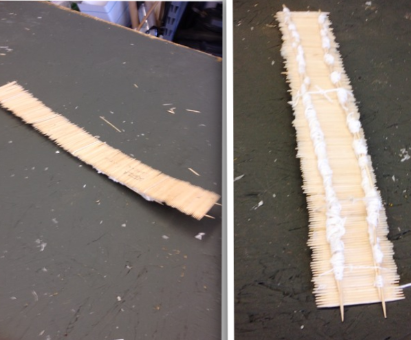
I recently just finished the engineering module, in which we had to design and build a bridge with a limit on materials and a list of requirements to meet. We began by writing down our design brief and sketching out some technical drawings of what we wanted our bridge to look like. Then  we combined all of our  ideas together, to obtain our final bridge design. The following classes we dedicated ourselves to building our bridge. During one of those classes we decided to weigh the pieces we had finished constructing with a triple beam balance the weight results we obtained for the bridge were a little upsetting and surprising. It turned out only a portion of our bridge weighed around  sixty grams, which meant we were twenty grams over the  weight limit. We had to remove a lot of the string we used to hold the toothpicks together and decreased the amount of string we used on the remaining parts of the bridge. We decided to keep our trusses, but decided to revamp the platform of the bridge hoping that would decrease the total weight of our bridge.


In the end our bridge supported a small amount of weight, but I was still very proud of my group members for not giving up through this tough building process and really giving it their all. With this module I also learned that you have to go through a lot of trial and error which can be frustrating but will ultimately improve your ending product. I really enjoyed completing this module, it was a fun experience to work through.


-Andrea S.

Medical Innovations Of The Future- Patty A.

For the past few weeks, we have all been working on different modules under 3 different pathways, which are, Engineering, Biomed and Media Tech. Each module is suppose to help us see more into the different pathways, which we will all have to choose one for high school.

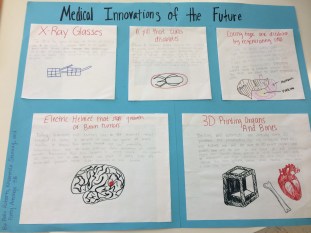
Recently, my group (Khammila and Bella) and I decided to focus on the Biomed pathway. Our challenge was for us to see how our medicine is advancing now and how it will continue to advance much more in the future thanks to our technology! We had to create a poster as a group demonstrating what medicine would look like in the next 10-100 years.

MIOTFAs we researched some ideas, we were all in for a shock! We all learned so much! Of course, we did come up with an idea ourselves, but just realizing what scientist and doctors are doing is just mind blowing. Something I learned about was the Electric Helmet That Stops Growth of Brain Tumors! Tumors are not fun to have. I’ve never had a tumor and hopeful I never will, but just seeing and reading personal experiences of those who have experienced and have tumors is heartbreaking. Not many people survive tumors, but many who do wish they could have done something to those who have passed away because of tumors. The process is long and expensive and no one wishes to die because of a tumor, especially young victims. The helmet is meant to help stop the growth of tumors, making it a little “safer” for the victim and giving the doctors more time to plan and take action (as in planning on better treatments/surgery and such). This is pretty big! Maybe in a matter of years an idea will be developed that would kill the tumor without surgery being needed!

What my group and I brainstormed and came up with was a pill that anyone can take and it would detect diseases. In many cases, diseases are detected at a late stage, making conditions worse. With this pill, doctors would be able to see any future possible diseases that  are in the very beginning on stage development and or see any warning signs for a possible growth to a disease, making it easier and safer to cure. Not only would this save thousands of lives, but pain.

Today, 3D printing exist. We have 3D printings of toys jewelry, food, etc. But the next big thing is 3D printings of human organs and possibly bones! “The idea of printing a human kidney or liver in a lab may seem incomprehensible, even creepy. But to many scientists in the field, bioprinting holds great promise. Authentic printed organs could be used for drug or vaccine testing, freeing researchers from less accurate methods such as tests on animals or on synthetic models.” -CNN. This can have many negative things, but lets face it, everything has its negative side. Now with 3D printed organs and such, scientist would be able to test medicine, etc, on the organs and not just animals anymore. Not only would this save thousands of animals lives, but they would be able to test it out on an “actual” human “body part” and see how it would affect the “human part” if this were to be taken by a person.

There is so much more  out there that I and thousands of others don’t know about! It’s so fascinating and exciting to see what’s being created and how not only would this affect us, but  generations to come! We are the generation in which a turn in medicine will occur and we all should be thankful and get our ideas out there! Next thing you know, we all pitch in and help develop a cure for diseases such as autism and down syndrome!