The Design Process

It’s been almost 3 months seen we got are makers space and it has been awesome! By now we all should have done 5 modules, now the modules that I have done or different from someone else’s because it depend on the pathway (Biomedical, Media tech, and Engineering) you want to go in to.

Engineering is the pathway I’m want to go into so I’m doing modules about that pathway. There are a couple of modules that are required like the design process modules (gets you familiar with the design process because in this class you’re graded on the process not on the product) and the blogging modules (which just gets you familiar to blogging) and 3 modules of your choice. I have done the engineering module, the mechanical systems module, and I’m currently working on my fifth module, computer and automatic drafting module.

Every mFeatured imageodule we do are supposed to help you gain a skill that we’ll eventually come in handy. All of the modules that we have done are fabulous, but I feel like the design process module is the most important and the least talked about.
As I mentioned before that Ms. Sauter (our teacher) looks at our process rather than our product, because the process is the most important part.

First, we identified the steps of the design process. The design process have 5 major steps; identifying your problem, generate concepts, develop a soluFeatured imagetion, construct and test a prototype, and evaluate solution. The first step, identifying your problem, is basically asking yourself what the problem is and decided whether or not your problem is valid. Generating concepts is just asking yourself what you need and have to solve your problem. Developing a solution is brainstorming (most important part) for an idea that will solve your problem. Constructing and testing a prototype is making the solution that you decideIMG_3765 was the best to solve your problem and making sure it works and if it doesn’t work make changes. Last but not least, evaluating solution is just making sure your problem is solved.

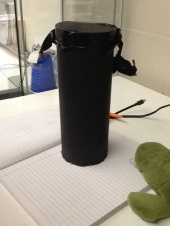
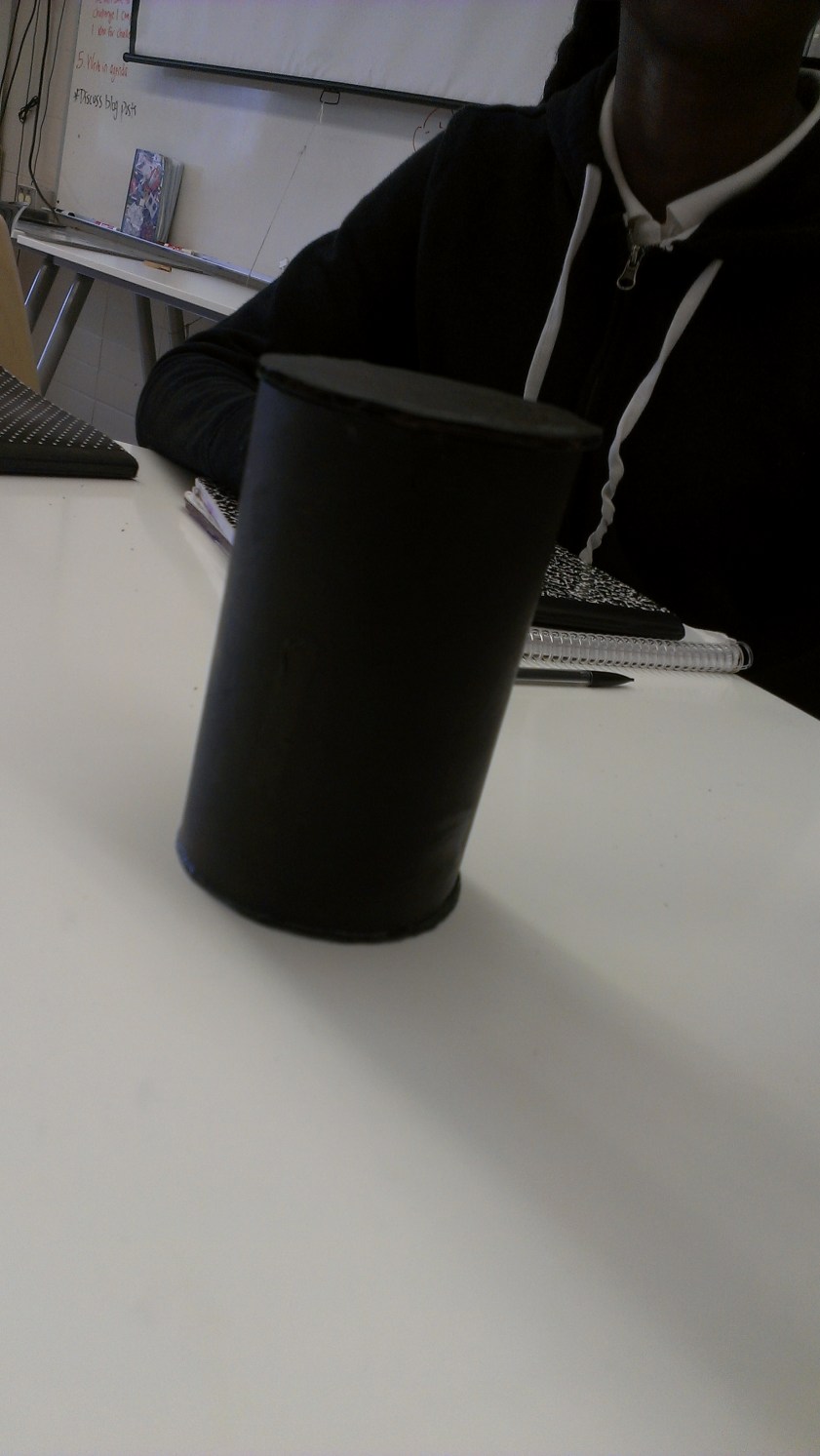
After, we got the design process down we made a speaker for Ms. Rutz (one of the counselor), practicing the design process. After that, we will know how to use the design process for every module we do!

Luz Cruz

Prosthetic Module

I enjoyed working on the Prosthetics Module because it was fun and difficult at the same time. The main idea of the Prosthetics Module was to build a better and comfortable prosthetic leg for people with amputated legs. We are doing this to have an idea of what  kind of pathway we want to have when we are in High School.

The Prosthetics Module was very difficult because I had to be patient and very open-minded. We used hard cardboard for the leg and another piece of cardboard for the foot. At first, we thought it was going to work out, but after trying it, the cardboard foot bent and of course, we couldn’t use it anymore. Instead, we used a piece of wood for the foot so it would be more stable and added some ropes too so you could attach it to yourself.

I enjoyed this module because we were very open-minded and we actually had the opportunity to build a prosthetic leg and even though we failed many times we didn’t give up and we gave our best.

BY: Sara Vilamizar

Fun Times in GTT

So GTT is one of the fun classes that we have at our school. We get to experience what some of the  pathways we are able to take in high school. You are able to be in a group of the people who have the same interest as you.

Like the main module that I’m taking is engineering. It’s really fun to do because you can get a feel of what it’s going to be like when you go into the pathway. The one I have really enjoyed was Computer Automated Drafting. It’s one of things my class did last year. I was always really good at it and it was really fun to do. Also being with the group of people that have the same interest it’s most likely that you will get along.

So there are many other modules that engineering has to begin with. The one many people like to have a competition with is building a bridge. The thing that makes it a little difficult is the materials you use is liquid glue, string, and toothpicks. Also one that many people will like and what I’m next is the construction module.

-Selena Antunez Gomez

Engineering in Gateway Through Technology

Gateway Through Technology is one of my favorite classes. The modules are fun, the Maker-Space is the coolest classroom ever, and it gives you freedom to explore and learn about the different pathways to prepare you for high school at Ann Richards. But sometimes these modules can be a handful. You have to worry about meeting deadlines and doing the module correctly and sometimes it can be a handful. And sometimes you have to get creative.20141107_100209

Engineering is one of my favorite pathways. You get to work on designing things and actually building something. So I expected the first module to be a breeze and for it to be really easy. Well… I was wrong.

Let me explain, so basically we were assigned to build a bridge made entirely out of toothpicks, string, and glue that was eighteen inches long, no more than four inches wide, and weighed no more than forty grams. This sounds fairly simple but trust me, it’s not. When my group was actually able to decide on a design that wouldn’t take us a month to build we had to figure out how to build it. First, we tried making bunches of about 24 toothpicks and attaching them somehow but they wouldn’t stay when we attached them. Next we tried making two long beams that were all tied together with string but that weighed way more than forty grams so we just took one of the beams away but that wasn’t stable enough. With one more class and a lot of frustration building up between all of us we found a way to attach some toothpicks to the side of the beam to help the stability. But there were other complications as well.

On our second to last class to work on this module our teacher, Ms. Sauter, had been dragged to a training so we had a sub who was really nice and let us about to do our work. But unfortunately we ran out of toothpicks. So if you saw two-three students looking around frantically for toothpicks then that was probably me. We checked the office, the art room, and the supply closet. Who would’ve guessed that no one had toothpicks anywhere? After giving up our search, my partners and I were stuck taking old toothpicks out of a box and either breaking them apart due to the fact that they were glued together or untying them due to the fact that they were wrapped in string from previous users. It was painful, aggravating, and tedious but we did what we had to do to get the assignment done. And at the end it was pretty fun seeing a final product. And it was also pretty fun watching that final product crack and break under the pressure of the 2,800 gram weights that we put on it to see how much it would hold.

Anyway, the point I am trying to make is that sometimes there’s going to be problems or setbacks but you can’t let that stop you. You have to keep pushing through all the hardships to reach your final victory at the end.

-Darby Buscemi

Haiku Learning: Good or Bad? by Allegra Green

Haiku Learning: Good or Bad?

Here at Ann Richards, we have many amazing opportunities. We have engineering classes, fun sports teams, and amazing teachers. Ann Richards is a college prep school, so all the staff members and curriculum guides us towards college. Ann Richards is a STEM school (Science, Technology. Engineering, and Math), but also has many fine arts opportunities. Having all kinds of classes allows us to be more well-rounded, preparing us for college. Many Alumni say college is easy, thanks to Ann Richards. Ann Richards has many similarities to college, including pathways (which are similar to majors), many extracurricular activities, and the amount of work. But my favorite similarity is Haiku.


Haiku Learning is a Learning Management System where teachers can create their own websites that allow student to do their work on, turn in homework, review lessons, and go to teacher given links. Haiku is very much like Blackboard, the online website that college students use to turn things in on, contact the teachers, and take online classes. But is Haiku good? Technical problems can occur while using Haiku, causing work to be turned in late, stressing the students out.


I wanted to see what other students think about Haiku, so I asked 2 students, one from 7th grade, and one from 8th grade, to tell me what they think. Below, is what I found out.

7th Grader
1.Do you like using Haiku?

Yes! It is very helpful for connecting with teachers.
2.Do you have many tech problems using it?

Occasionally, when I use my tablet. But that is just because my tablet doesn’t support Google functions
3.Does using Haiku help with school?

Definitely! It is very helpful in a project in the Ecopreneurship class right now.
4.What do you like/dislike about haiku?

I like that I can be in contact with my teachers and get all the Flip videos and such.

8th Grader
1.Do you like using Haiku?

Yes I do
2.Do you have many tech problems using it?

Not really, Although other students have crashes, I haven’t
3.Does using Haiku help with school?

Yes, you can use it for all the classes, and you can submit online, making things easier.
4.What do you like/dislike about haiku?

I like that it’s online, and everything is there. It’s very organised

From all the information I gathered, I can tell that everyone really likes Haiku! I know that from using it over the years at Ann Richards, the students will have an added advantage in college when they have to use Blackboard. I think that the students of ARS should use Haiku, because it is a helpful way to do our homework, makeup work, and contact a teacher, along with preparing us to use Blackboard in college.

Haiku

Ray of Light Through a Pinhole by Ana Rosero

Making a pinhole camera
The main idea of this module was to think about photography, and how its a really important part in expressing our ideas. Our challenge was to create a pinhole camera, that actually works. We used Kodak instructions to help us make our pinhole camera. We interesting stuff. also used a Pringles container, that we later had to paint black, film, masking tape, a push pin, aluminum foil, and scissors.

We had to make the camera totally dark, so that the light wouldn’t ruin the picture that we had to take with our camera. To ensure this we spray painted our can, covered the pinhole with black masking tape, and we covered the lid of our can with masking tape as well. The process was easy, and quick.

My experienceimage
At first when I found out that I had to make a pinhole camera I was a little scared because I didn’t think it was possible for me to make it work. But after we started to work on it and got more into our challenge, I felt really confident that our camera was going to take a good picture. The instructions really helped us and another good thing was that my group members were always prepared, they helped me if I was confused on what to do. I think that the hardest part of making the pinhole camera was making it completely black.

Media Tech
Media tech is the pathway I’m planning to take in high school. Now that I’m actually learning about things that they do in media tech by making stuff, I’m really enjoying it. I’ve always liked cameras and taking pictures. But media tech takes it a step further by teaching students how to edit videos, and camera angles and a bunch of other interesting stuff.

My PLTW Experience by Anjelica Arias

To me, this PLTW experience so far, has been very hectic, but at the same time I have enjoyed every part of it. When I first heard that we were going to be building a lot of things for each pathway I did not think that we would be doing as much as I thought that we were would. I thought there was going to be something that we did last year in PLTW, but I was wrong.

This year’s PLTW we are introduced into our three pathways, which are Media Technology, Engineering, and Biomed. They all have different modules, which are basically different challenges or tasks that go deeper into what it is going to be like in each pathway.

Personally I have become a real fond of the Media Technology pathway, I really like how you can create movies and edit videos. I find it very interesting the way that our world now revolves around technology and we depend on technology for everything in our everyday life.

Even though I only was able to do one of the modules that was provided for us which was to create a pinhole camera. Even though there was a few times where it was really confusing to understand the concept of it, or the designing process, the ending outcome was really enjoyable and I would like to do that again.

I think that if I was to start with the Media Technology pathway and continued with it that I would have really liked the outcome and got to experience what would happen in that certain pathway. I really wish that there was more modules for the Media Technology or like a specific workshop for people that are really interested in that pathway.

Personally, I feel that I have changed into a different and more open person through this experience. I found myself wanting to know more about a pathway that I am very interested in, which is Media Technology. I want to know what it’s like going in that pathway and finally doing something that I have been very interested in for a while now.

I like how I can find new things with certain processes of the different modules. I find myself changing in each way when I do a certain module, or whenever I am designing something for a certain module. I am really surprised with the outcome of myself, and of each module.

This PLTW will be a class that I will never forget. It made me the person I am today, and made me more excited to see what more and more of the modules that I will discover in my eighth grade year.

Prosthetics by: Jacinda Patina

This module was a brain worker! It started off as or original design but since we didn’t have access to certain materials we couldn’t build our original design. We had to change our whole design and think of a new design.

We had a hard time but then we decided we would use foam (from a water noodle) as the cushioning and just attach it by string, but e put the attachments in the back burner for now and just tried to build the leg itself. The materials have changed along the way.

For the foot we started off with a piece of cardboard, but after we spraypainted the foot it got really flimsy so that was a no. Now we only had a cardboard tube and that was it. We didn’t know what to do now. We thought of using wood for the foot but we also had some doubts like it would be to heavy but, after a while we had to resort to the wood foot. It worked out way better than we thought.

We attached everything and then we had to figure out how we were gonna attach it to the leg. We got string and drilled some holes and tied the string to the leg and ran the rest of it through our belts and then we were done.

Well thats what we thought as soon as we tried to walk the foot fell of the leg. Clearly the hot glue wasn’t working so we were done with that. we didn’t know what else to put we tried wood glue gorilla glue but it just would do the job so then we thought of tape.

The first time we tried out the tape it was really flimsy so we thought we were out of luck. But we didn’t quit there we wrapped the foot in tape multiple times and it finally was strong enough for us to walk in! We were so happy!

Jacinda (me) walking in the prosthetic leg.

Jacinda (me) walking in the prosthetic leg.

Procedures for Prosthetic By Bella Thomas

Procedures for Prosthetics
by:Bella Thomas

In PLTW class we create various things and projects to finish modules. One of the modules that I recently finish was a biomedical module. in this moduleI had to create a prosthetic leg.There are many steps that you need to know or have to do in order to create a successful module. Take in mind that we didn’t have really expensive materials.

The first step that we do in order to create any product is making a Design Brief. The Design Brief is the written plan for the project. In the Design Brief we clarify Who the clients is,What the problem is,How we plan to fix it,What the design will need,The constraints of the product and What we will deliver to the client. By creating this we make it easier for us to design a helpful product that will be successful.

The next step is design the potential products.By doing this you can design as many ideas that will or will not work and you can find the best one for the job.
After you create your design then you pick your top 3 and evaluate them. To evaluate them you have to create a grading box.In our grading box we used Size,Productivity,Safety,Comfort,and Durability to decide wich was the best design idea for our module.Once you finish those steps then you build.

The next step is Building and Revising.The first draft of the prosthetic needed a plunger,duck-tape ropes,cardboard foot,cardboard leg wrap, and a p.v.c. pipe.When we started making it we noticed that there were no plungers available,so then we had to go back and create a whole new sketch.After we had the new sketch we started building it;we used cardboard for the foot, thick cardboard for the leg base, foam for the attachment to the limb,and felt on top of the foam for the comfort but the card board foot wasn’t strong enough to hold and it kept imploding on itself.Finally we decided to switch out the cardboard for wood and add ropes for support.

The final step to prosthetics is Reflection. When we do reflections it helps us understand what it is that we learned or what we can get out of doing this activity.this step is the step where everything really clicks and you realize all the good skills you’ve gained that can pay off in the future. The skills that I learned were how to work with what you’ve got and to be determined in whatever you’re doing.These will pay off in the future because when I am much older and have a job I will have to be determined so I can reach my goal of success. I really enjoyed this module and can’t wait for the next.The picture below is the final product .The person wearing it is my Co worker  Jacinda Patina image-5

Medical Innovations of the Future: By Samaria Shearrod

Project Lead the Way (PLTW) is a very large portion of life at the Ann Richards School. It is a required course in grades 6th, 7th, and 8th that provides students with the opportunity to get a taste of the major job fields available. Once you reach high school, you will have to pick a specific pathway, (biomedical science, Media Technology, or Engineering) that should help jump-start your future career.

This year, we get to have a little more freedom and choice over the assignments we do. Over the course of this school year, I have completed almost 5 different modules , each from different pathways. Each module shows you what that pathway could be like, and it helps you decide what you really want to do later. One module that really stuck out to me was “Medical Innovations of the Future’’, from the Biomedical pathway.

This module really made me think about how things are going to be 15,20, or even 100 years from now. Medicine and health are two very important components to human life, and the possibilities of how it could change for better or worse sparks my curiosity.
The actual assignment had my group do a bit of research over the topic, and then create a visual representation to help others understand the topic as well .
IMG_5548

After completing the module, I realized that I actually did learn something. I found it really interesting that doctors and people in the health field plan to completely change medicine with a digital approach in as little as 20 years from now. Even though I thought it was beyond cool when I first saw it, but after thinking about if for some time, I asked myself, “What’s wrong with the medicine we have now?” It seems to work just fine now, and even though a more technological way of thinking may seem the most innovative, is it really the most efficient choice?

The future of medical innovation is a complex topic, that I don’t think I can fully analyze just yet. But as I slowly gather more and more knowledge with age, I’ll hopefully one day be able to understand and be apart of it completely.