Engineering: How To Build A Toothpick Bridge

It all begins in how you plan to design your bridge and how you plan to build it. You first try to design a technical which means that you draw out your idea and how you are going to build it together to make it supportive to hold a lot of weight, but with the material provided.

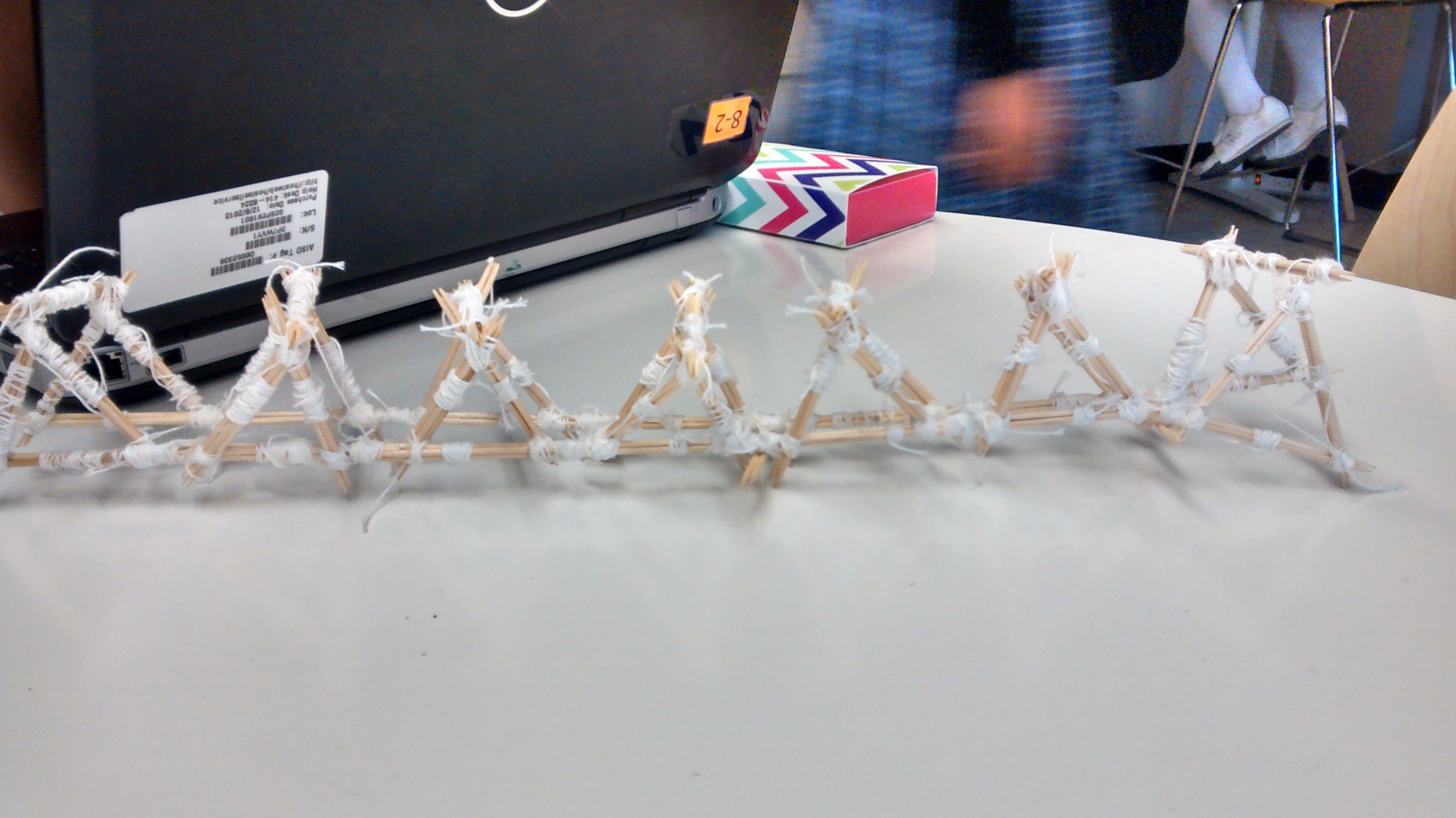
20141104_092235The second part of building a toothpick bridge is starting to put it together. Which means you look at the technical drawing and see how you design it. You then start creating your bridge the way you plan it, with only string, glue, and toothpicks.

The third part is testing out how much your bridge weights, which means that it could not be more than 48 grams heavy. But your bridge has to be a maximum of 18 inches long or a minimum of 16 in long. While you are building your bridge you have to take concern that the bridge would be an inch apart from the platform to test it out.

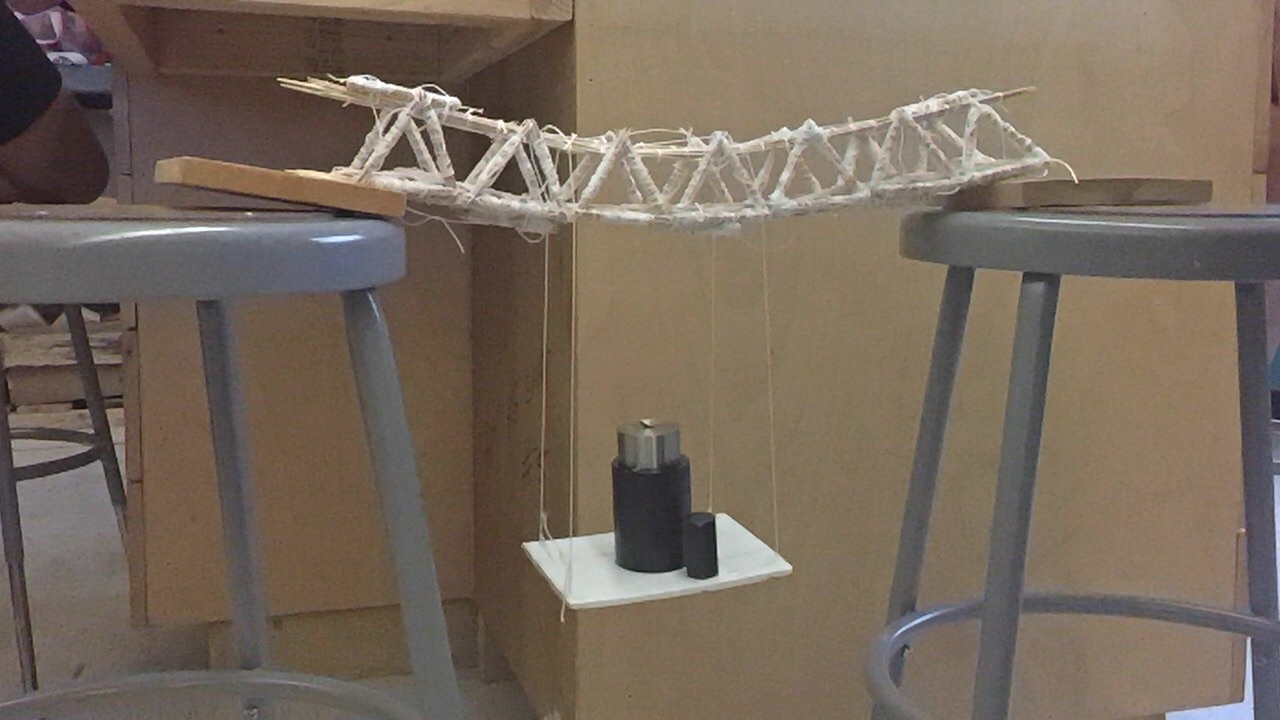
IMG_20141104_094033824_HDRThe last part you locate your bridge in the platform and the start putting grams on it to see how much it would hold. When the bridge collapse see how much it hold and then write down your testing report and done.

The reason I choose to write about engineering is because I wanted to build something that I can design and create. So if are interested to create something the best thing to do is by taking engineering classes or as a pathway because it is never too late to start doing something you enjoy.

By: Jennifer D.A.

What is engineering ? My experience with engineering.

What is engineering?
Engineering is the process of designing and making something come to life.Just like those everyday bridges,roads,buildings,guess who made those?.Well Engineers,they designed it which is not a quick process and it takes forever to come up with the correct idea but after they get the right idea they build it and there it is, A great designed perfectly saved building.

At Ann Richards were required to take a class called PLTW this class consist of modules(projects and instructions on to do build something,produce something,or think about how medicine will change over time)this class will help us choose the pathway we want to take in high school.Personally the module I enjoyed the most was the engineering, in this module we had to build a bridge and it had a couple of constraints and those were challenging to follow but overall our final project was a success only the weight was.

Like I said before we had some constraints and that was somewhat challenging the hardest constraint to follow was the weight our max weight could’ve been 40grams but our bridge ended up weighting 108grams which was a problems but it could hold 1,400 grams which was a success because we thought it was going to break right away but it didn’t.

Overall, I enjoyed this module and it light up something inside me which I might wanna take engineering as my pathway because it seems so interesting and just the idea of designing and building something is incredible imagine how your gonna feel when you see your final product and see that it worked its a great feeling.
Karla Jaramillo

image

The New Maker Space By:Michiah Thomas-Thompson

The Impact

Having the Maker Space has made such a positive impact on the 8th grade PLTW classes. Last year our PLTW room was not the biggest or the safest to create all the cool thing is that we are creating this year. Having the space and new equipment has made this PLTW completely different in a good way. We have so many new opportunities for projects with the Maker Space being available to us.

The Projects

Being able to do my projects in the Maker Space has been such an amazing experience. A lot of schools don’t have the materials for their students to do the projects we do. I just finished the second challenge in the Introduction to Photography. But I believe my favorite project was the Video Production for the Media Tech Module. I enjoyed it so much because of the freedom we had while creating the video. I love that we have the Mac Computers to do the editing, because I believe that Apple has the best video editing program on its computers.

The Maker Space

The Maker Space is very well decorated for one. I like how fresh and fun the first room of the Maker Space looks. Having the Maker Space be so open makes it easier to work ,because you don’t feel clustered in one room with a bid group of other students. The second space in the Makerspace is the room of creativities as I like to say. Its the room where we really work hard ,because it has all the materials to create all our cool things like a prosthetic leg. We also have all out main materials to create all the different things like the leg. Another thing is that its where all the huge and small equipment is and were all the messy or sharps materials and tools are.

Why we need the Maker Space

We need the Maker Space because we are a school full of creative minds. Having so many people that are so creative go to this means that people are going to want to create or try out so many different things. And having the Maker Space gives them an opportunity to create something ,and it could possibly be a success. Having a place where you can be open minded and it is open minded to your ideas is something I believe everyone wants.

Building a Bridge

Jazmín M.

Hey Guys!

I am going to talk to you about my last module I did I did these last six weeks in PLTW. What is PLTW? PLTW is one of the many fun classes they provide for us here at the Ann Richards School. PLTW stand for Project Lead The Way. The class is supposed to help us choose what path way we would like to take next year in High School. There are three path ways and those are Engineering, Bio-Med, and Media Tech.

This last module I finished was a module based on Engineering. In this module my group (Lucero and Jennifer) and I had to design and build a bridge. The bridge we had to build had certain requirements and those were:

  • Span: 16” between bearing points (should be longer than 16″)
  • Bearing: maximum of 1”
  • Height: 4” max.
  • Width: 4” max.
  • Weight: 40 grams max.

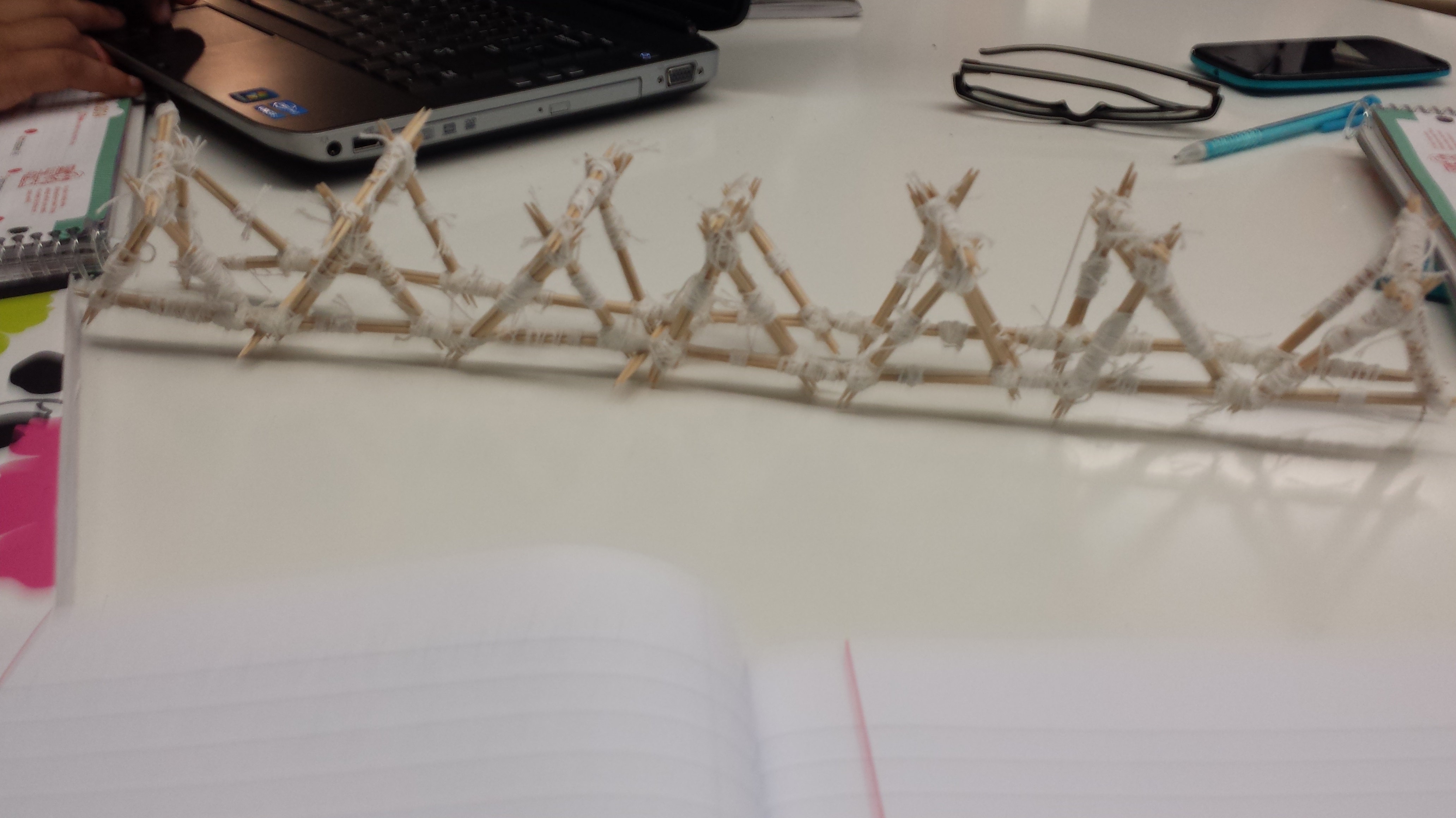
The materials we had to use to build this bridge were round toothpicks (2 ½” x 1/16”diameter), cotton thread, and glue. My first thought was “How in the world am I going to build a STRONG bridge with only those materials?!?” But me and my group worked together to design a bridge that we thought would work best. We decided to make our bridge out of triangles, since triangles are stronger that squares. So the first day of building we spend the whole class period making triangles with the thickness of three tooth picks (so each triangle had 9 tooth picks). This was a really hard process because at first we didn’t know how to tie the triangles properly so that they are strong. The good thing is that we had glue. So we tied the triangle and then put a little glue to secure it even more. Then when the triangles were done we connected them with more tooth picks at the top, and there was our bridge! The bridge ended up weighing 31 grams and it hold 400 grams. I think we could have done better.

20141104_095637
Overall I really enjoyed this module I learned a lot about engineering and I had a lot of fun building and designing this bridge.
Thanks for Reading!

Engineering , Construction and Fabrication Basics

In the engineering module, construction and fabrication basics, my group and I built a birdhouse that was built around the measurements for a Black-capped chickadee bird net habit. But before that we started off with an individual project by making a wood sandwich to set us up for the drilling and hammering we might of have to do when building our bird house.

image
When builting the wood sandwich I used a drill, a hammer, a socket wrench, a combo wrench, clamps, nails, countersink screw, round head screw, hex nut, wingnut, washer, drill bits, and two 6″ 2×4″ pieces of lumber. I put the lumber on top of eachother and clamped them to the table to stabilize the lumber while I drill holes and hammer in nails. First I hammered in the nail. Then, drilled holes for the countersink screw, round head screw, hex nut. Then, I drilled the countersink screw, round head screw into the board. Once we all finished making our wood sandwich we made our bird house.

image
When building the bird house we had started off by getting the wood and measuring the length of each board (7″,9″,12″,15″). Once we had our measurements we cut the boards and glued and clamped them together. Once the glue was dry was spraypanited the bird house with yellow as a
base and pink, purple, and white as effect colors. Once the paint was dry we use a brad nail gun to nail the boards together.

Engineering modules are really fun for me because I find engineering more interesting then other pathways. Working in this module was fun getting to work with tool I had never use and getting to know how they work and the different thing it can do.

~Ora Edwards

Project, lead the way

By: Brenda Puente

PLTW is a class I’ve been taking for two years now, like the title PLTW stands for project lead the way, thus in this class we learn about things that can be built or how things work and at the end for some of us we get to work one on one with them for the first time.

For example, The last six weeks I got to do a module with my group that had us make a video, about an invention that can be made in the future using media tech, we came up with the ipod locker. What this is, is a locker that has an ipod attached to it and could open the locker using a pass code that you set up and type in to open the locker, and keep track of what you put in the locker and other things like keep notes and play games if you were bored, basically just an ipod on a locker.

In this assignment like I said before, we had to make a video which we had to film and edit, of course none of us knew how to make a video except for me and my small knowledge from the big amount of YouTuber’s I watch so I lead most of this module.

The first part of this process was to film the video, which was very awkward because we’re not really used to setting up a camera and filming ourselves, so eventually this led to a lot of laughing, goofing off and messing up in front of the camera but somehow in the end we sucked it up and finished filming the video.

The next step was to edit it, I volunteered to do this part too because I thought it would be easy… not really. It took us a whole class trying to figure out how to crop a video and then once we figured that out and asked for help everything else went smoothly. Also life lesson kids, if you don’t know how to do something DO NOT BE AFRAID TO ASK FOR HELP! it will really benefit you in the long run like it did for us.

In the end the video thankfully turned out great, and this was very good learning experience for me, I learned how to edit videos on Imovie and it may or may not benefit me in the future when I decide to follow the media tech pathway.

Thanks for reading!

Our I pod locker video – https://www.youtube.com/watch?v=fxxxnt_swqs&feature=youtu.be

The Engineering Pathway: Bridge Challenge

By: Lucero Martinez

There are different pathways and it all depends on you in what pathway you want to study. Some of the pathways that there are is bio-medical, media technology, and engineering I have chosen to do engineering because I like building and being creative in what I’m making, Im also interested in learning what is engineering and why engineering is important in our society.

Taking the Pltw (project led the way) class has helped me to learn about engineering and the brief things I need to know about engineering. Pltw has developed my understanding for engineering and also for the biomedical and media-tech pathways. It has been fun doing different modules about the different pathways because I’m creating something new every time and I’m also learning at the same time. Recently I did the bridge challenge module and that helped me get a better understanding of engineering and it was fun.

For the bridge challenge I worked with two of my other classmates and we created a bridge with a list of materials and requirements that had to be meet. To begin with this module we first had to create a design brief and also start sketching out how the bridge will look like.When we had all decided in how the bridge will be like we made our final design brief and then we started constructing the bridge. During the constructing of our bridge we had to use a triple beam balance to weight the pieces of the bridge we had to do this because one of the requirements was that it had to be 40 grams and we were happy with the weight of our bridge because it was about 36 grams.  But It was some what a little difficult making the bridge with just 3 materials which were string, toothpicks, and glue but it was okay because we had finally finished our bridge and we actually did good because it supported a good amount of weight and I was happy with the final product.

The New PLTW

By Hope Calderon

What exactly is PLTW?

PLTW is one of our many classes here at ARS. PLTW stands for Project Lead The Way. Project Lead The Way is a class that has provided us the advantage of giving us an idea of what pathways we could choose to do in High School. The pathways that are offered here at ARS are BioMedical Science, Media Tech, and Engineering.


This new school year, ARS staff and students came up with this idea of having a Makerspace where we can have a classroom dedicated to making dreams come true. It all started with a dream and now it’s reality. We got the Makerspace started with a couple of grants from organizations who believed in us. They believed that they could help us make our dreams become reality. In the beginning of this school year we used our school library’s bio-room as a classroom. The bio-room was the average size, about as big as a classroom, but the unfortunate thing was that we didn’t have supplies. We didn’t have the supplies to do our projects (modules) with. Modules are these projects that we do, to get an idea of what that pathway would be like. So far I have been interested in the Media-Tech Pathway. For Media-Tech I have done the following modules: Intro to Media-Tech, Blogging, Intro to Photography, and I am currently doing Screen Printing. From these past modules that I have done, I have learned a ton of things. Some of the things I have learned are to let out your inner creativeness, to always work your hardest, to always look at the bright side of things and to never give up! This class is very challenging but it’s amazing!

Instructions

Alexis Miller

Instructions are a big part of our lives from a pack of ramen to a big project. Everyday aspects of life require instruction that we don’t even realize. What if your pack of ramen did not come with instructions or if your teacher did not tell you how to do a big project. What would you do without instruction? Giving instructions is sometimes easier than receiving. For me I can give them but when it come to reading instructions I tend to skip around. I have learned over time that in order to succeed both need to be balanced.

I am talking about instructions because in our PLTW class we have to read online instructions to complete our work. Our teacher has instilled the importance of this skill in our minds. My groups have asked questions and our teacher has used her default yet valid answer “Did you read the full instructions?”. Our answer was no. I realized how easy it was to take one extra step. This was a turning point for me in the class and I began to read and re-read instructions.This class is about exploring pathways, yes,  however we are also practicing this skill to large extents. If we don’t follow instructions then we get a bad grade and let down our group.

A lot of are tired of “hearing to read through all of the instructions” and so am I. I have learned however that sometimes we have to deal with what we don’t always like, instructions being one of them. I encourage you to read through all of t he instructions you may just learn something.  It takes more time but it saves even more.

ramen

Building Bridges

By Izabella Matheson

Ever heard the phrase, “build a bridge and get over it”? Surely you have, but do you actually know how to build a bridge? I can happily say that I do! Now, I wouldn’t refer to myself as a natural born architect or anything, and I still found constructing the bridge to be not only enjoyable, but also fairly simple, so I encourage everyone to give it a shot, even if it may not seem up their alley.

In my GTT class, which stands for Gateway To Technology, we must choose a different module every few weeks to work on in class with a group. I decided to try the engineering module for my second module about a month ago, wanting to try something new because, hey, maybe it would be fun? I can honestly say that it was indeed, fun.

I remained with my same partners from the previous module I completed, named, Zoe, Zoë, and Cloa, so I was excited to work with them again. Unfortunately, I was absent the first day of in class work and I missed the first challenge, which was to interview a high schooler in the engineering program at our school, but my group was there for me and did the assignment and filled me in on what I had missed. After that, we began formulating ideas for our bridge, beginning with a design statement so we could understand the criteria of the bridge. The bridge had to weigh less than 40 grams, have a span of under 16 inches, and be made completely out of toothpicks, glue, and string.

Our next step was to create a design matrix to help the four of us decide which bridge design would be the sturdiest and hold the most weight, which was the purpose of the module. After comparing two different designs, one being to give the bridge trapezoid shaped supports, the other to give the bridge triangle shaped supports, we decided the triangle structure would be the best choice as it would weigh less than the trapezoid design and would support more weight. After we made the decision, we got to work making triangular supports and the rest of the bridge by glueing toothpicks together, which proved to be quite a messy task.

Then, being the strategic geniuses we are and seeing how the glue was taking quite a while to dry, we borrowed a hair drier and used it to speed up the drying process. After the pieces of the bridge were dry, we tied them together with string and put the finishing touches on it, and then, we were done! I believe I speak for everyone in my group when I say that I felt so much pride in completing the bridge. However, personally, I was also a little relieved that I was no longer going to be going home picking glue off of my palms anymore.

There was still one thing, though: we needed to test how much wimageeight our bridge could hold. We tested our bridge and found that it could support 2,600 grams of weight, which truly was astonishing and filled me with pride once more. I was glad I took the opportunity to try something new, because throughout the whole process, I actually had fun.