Adventures in Toothpick Finding

image-2

Not so long ago, in the very classroom I am typing in now, there was a short crisis. A group of three girls were doing a module that involved toothpicks (they had to build a toothpick bridge), but no toothpicks could be found. It was also two days before the due date of their module, and they were out of toothpicks. To make matters worse, there was a substitute teacher.

I was one of those girls. Along with my partners, we searched the Makerspace for these little wooden spears. There was plenty of string, plenty of glue, but no toothpicks. We then tried to think of who in the school would have toothpicks on hand. One of my partners and I set off to the Art classroom.

The Art class was in session, but the teacher was happy to help us. He also lacked toothpicks. This was quite unfortunate. He directed us to the assistant librarian, whom also did not possess the tiny spears. She sent us off to some more classrooms, none of which had toothpicks.

Tired and slightly annoyed that nobody in the school seemed to have toothpicks, we headed back to the classroom. The third group member hadn’t had any luck either.

“What should we do?” one of us asked. I forget who.

“Maybe we should check some more.”

“Nah, nobody has any. We should try to find some here.”

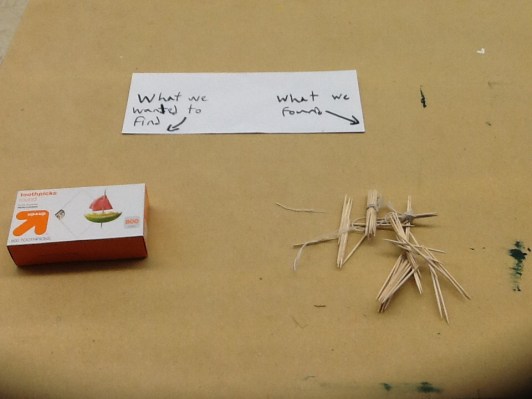
“There are some old stuck-together toothpicks in this box. It would be kinda hard to get them apart, but… They’re toothpicks.”

“Let’s use those!”

We then set off to work breaking apart the glue-encased toothpick bundles. It hurt quite a lot, as the glue had probably been on there for a month, and toothpicks are rather hard and sharp. We then glued the freed spears together into our own contraption, and were quite satisfied with our handiwork.

The next class the teacher returned, and so did the toothpicks. In conclusion: Make do with what you have. Also, little wooden spears are not as common as you think.

~Avery

Building a Birdhouse by: Sandy Sanchez

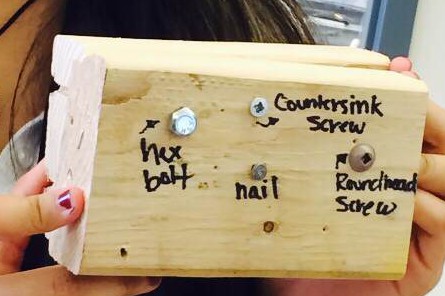
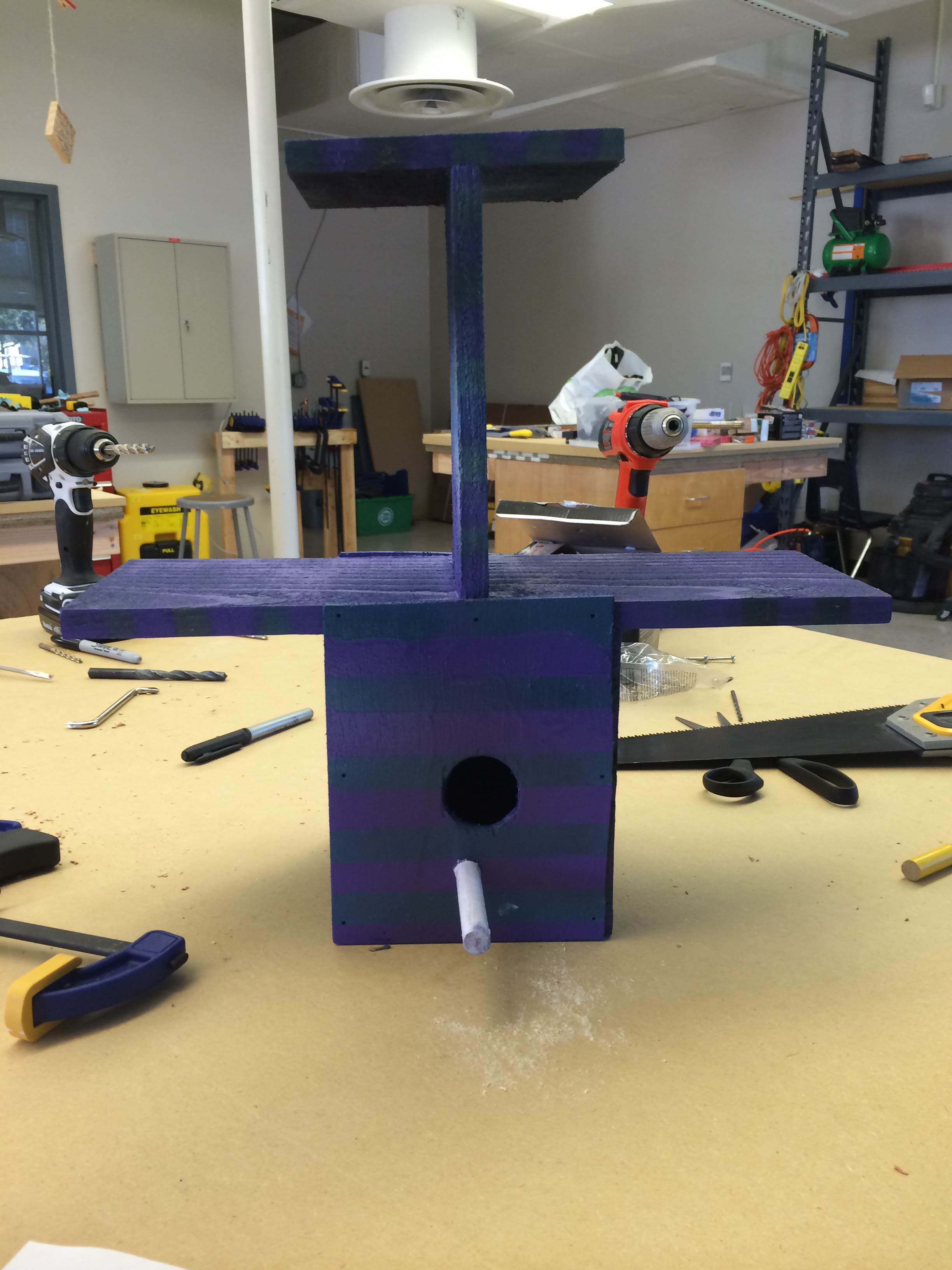
attachment_44825399IMG_4644During this year in 7th period PLTW, we have been doing modules left and right. And my favorite so far is quite obvious to me. It was the Construction and Fabrication Basics module. Now in this module, my partners Marlene, Astrid, and I designed and built a real birdhouse. This birdhouse had to have some requirements and restraints. It had to be only right angles, but we could be as creative as we choose. To make this birdhouse, we got to use drills, a miter saw, a jigsaw, a brad nailer, some clamps, a hand saw, sanders, and a hammer. Most of these tools I have never even heard of before! But now I can use every single one! A way for us to get the hang of these tools was to build this wood “sandwich.” It was basically two pieces of wood held together with different types of screws. Finally it was time to start the real birdhouse.

One of the reasons I loved this module so much was because I felt like I had a real connection with it. I mean, I’ve never built anything besides a lawn ornament before. (And may I just say, the birdhouse came out much better.) Another reason is because I got to work with my best friends. And we really got to work as a team and we did pretty well!

This project also had to come with some struggles too. For one, we had to learn how to use all the tools foreign to us. My favorite one was the brad nailer. I really liked the sound it made every time you would press the trigger. So yeah it was hard getting the hang of all the equipment but overall it went great. Another thing that was a little complicated was the painting. We had to make sure the colors went well together, that it wasn’t too thick of a coat or a too thin coat. We also had to think of a design. We decided to do black, white, blue and purple. And we also decided to put blue and purple stripes on the front. But I think my favorite part about the painting was getting to use a spray can for the first time. Another challenge we faced was knowing what tool is called what. But I did get the hang of it pretty fast.

Overall, I feel like this project went really well. Now I have background knowledge on how to work all the tools and design something similar. This has also really opened my eyes about engineering and what else I could accomplish. I am really happy that I got to be apart of the whole project. This has really opened my eyes about engineering and what I could do in it. So I am very glad we did this module the way we did. And I am ready to begin the next modules.


For the Birds by: Astrid Jackson

(I know, cheesy right?)

attachment_44825399

Hi! My name is Astrid and I am in 7th period PLTW. So far, I have been working a lot in the engineering modules. The most recent one I have completed has been Construction and Fabrication Basics, in which we built a birdhouse. We got to use tools such as clamps, a hammer, a hand saw, sanding blocks, drills, a jigsaw, a miter saw, and a brad nailer. My group, Sandy, Marlene, and I, built a right-angle birdhouse together. This taught us a lot about teamwork and collaboration. We worked well together. We all had something to contribute to the group.

attachment_44824843

While building the birdhouse, we had many challenges along the way. Some of these included getting used to the tools so that we were comfortable using them. We became good at using power tools through the course of this module. I became particularly skilled at using the miter saw. I was able to get a clean cut every time. We also had issues with painting the birdhouse. None of us had really used spray paint so it we kept on putting either too much or too little. With all the problems we had, this was still a beneficial learning experience.

Overall, I think this project taught me more than any textbook could have. We got to use real-life skills that we can apply to our futures in our career. I am planning on becoming an engineer, so this module was really helpful and I got a feel for the engineering field that I might not have gotten otherwise. Even if someone wanted to do something else, they could still use the skills like teamwork and getting a group project done on time and have it be great work. For all these reasons (and the fact that it was FUN), this has been my favorite module and I look forward to more projects to come.

Pathways

By: Celeste Gonzalez

Pltw (Project lead the way) in 8th grade is helping us choose our pathways. Here at ARS we take a pathway course. That means we will take a class based on Biomed, Engineering or Media Tech. In PLTW we are doing Modules. A module is a series of challenges based on Biomed, Engineering, or Media Tech while still being in relation to PLTW. Biomed is the study of natural sciences. Its basically, studying to be a doctor. Engineering pretty much explains itself, its the creation of something. Media Tech is working on computer, cartoons, designs, all having to do with the creation online.

I am going to be honest, computers and I have a complicated relationship, but I still love to surf the web. I don’t understand them and I don’t think I would have the patience to learn. I am very bad at math and Engineering has a lot of math and measuring involved, so I really don’t know about engineering. In Biomed you look at blood and integrons and sometimes I twitch at that.


These pathways have their pros and cons I have interviewed two of my sisters about their pathways (not really sisters, but upper class girls. At ARS we call each other sisters because we are family to each other). Jennifer, a student in Engineering, said, “You need to have a lot of patience and also be willing to learn from you mistakes.” So, Engineering involves a lot of time to think, plan, and solve which is quite troubling for me. My other sister is in Biomed and she said, “Biomed is something you would really use in life. Biomed helps you in everyday, whats hard about biomed is retaining all that information.” The thing with Biomed is that knowing, and perfecting is important, like really important because someones life could be depending on your skills and knowledge. I am really bad at putting attention to details, so that would be a skill I would need to learn. Now, I haven’t interviewed one of my sisters from MediaTech, but I have a ‘sister’ (ARS sister) Lizeth, and she is in Media Tech, and she says what is hard is getting use to knowing the software and all the parts of the computer. I am terrible at computers and pretty much anything related. I do not understand it, I just don’t.


These three pathways are hard, but luckily we have amazing teachers to show us the way, that’s why I haven’t eliminated any of the three from my choices because as an Ann Richards girl I will persevere and be determined to what I do. So honestly I could be good at any pathway if I work really hard. And that is what the Ann Richards girl is all about and anyways, at least I have the rest of the school year to choose.

Can You See The Future?

We all know the game the Sims. You’re in a real life simulation. But how can simulations in any way be used in the medical world?


My group and I, were completing the medical simulations module. I had no idea what that even meant. At first I was like, what even is this? It made no sense to me. I started asking around to people in other classes. Did they do it? Did they understand? But no one I asked had a clue what I  talking about. I came into class wondering if Mrs Sauter could help. And right away she explained it to us, and it started to make a lot more sense. If I had to, I still couldn’t explain it to someone else. But it made sense to me and that’s all I needed.

We started looking at the website we were given. It has a lot of different types of simulations. Not only does it have stuff for medicine. It has many for math and engineering as well. After we had picked one we analyzed it. It took a while, and a lot of researching to understand what everything meant. But sooner or later we got it. We started working on our presentation, and it seemed to get easier. But then when we started predicting with our simulation, it got a lot harder. It took me about an hour and a half to make a strong prediction, and get our simulation to test it. But never the less, we finished and I was quite happy about my presentation. Want to see exactly what this website looks like? Click this to see the amazing website the is The Wolfram Simulations.

Simulations are used everyday. They help us predict, almost everything. Scientist and doctors could use these simulations to help predict how many people could be infected in the sudden outbreak of the Ebola virus. The simulation we used, was an epidemic simulation. Doctors, scientists, or practically anyone could use it to try and predict how many people will get infected.

Simulations, like stated above can be used in any fields. How are these simulations made, you ask? Well, what is behind these simulations is a long series of complex mathematics. When Mrs. Sauter told me she had help assist someone in the making of a simulation, I was left dumbfounded. I wondered how much math that must’ve took. So in some of my free time, I started researching what type of math was used. It was some very high complexity of math equations, that I have never learned in all of my 13 years.

Overall, the idea of simulations is very intriguing to my mind. I had no idea that something like this existed till I did this module. This module left me very knowledged. I know how to analyze these models. Of course it took me a while, but in the end, I know a lot more. If you want to  know more about this, or if this post left you intrigues as well, I very highly suggest that you take a look into these simulations. What you find may change the way you look at things.


  • Nishi Patel

From Sandwich to House by: Marlene Mora

Lately I’ve been exploring engineering modules in class with my group in PLTW. My name is Marlene Mora and I won’t lie, my first option wasn’t always engineering. I had thought that biomedical science was more of my thing. That doesn’t mean I completely dismissed engineering. The recent module I completed was an engineering module called

Construction and Fabrication Basics. The reason I decided to try this module was because we got to build and birdhouse and you can’t tell me you’ve never wanted to build a birdhouse. Am I right? Well I figured this would be a great introduction to a couple of main things. Creativity, tools, and teamwork.

At the start of this module we did the basic design process and that’s where it all really started. I was kind of nervous in the beginning because I had never really built anything and the prospect of using power tools and even regular tools was kind of intimidating but my friends helped me work through it.

Our first challenge was to make a wood sandwich and that was more of an introduction to the real stuff we would be working with. This was just a simple project to get us familiar with the power tools and with different screws and bolts. Even though we struggled a bit I feel that without that experience we wouldn’t have been as comfortable building the birdhouse then if we would’ve just jumped in.

IMG_4644

Now the birdhouse. This was definitely an interesting experience. We had moments where we were all like, “OMG I can’t believe we were able to do this!” Or we would have those, “ We’re never going to finish, this is a disaster!!” I felt the most frustration during the process of using the tools or when things didn’t go exactly how it was planned. For example after we had finished building the birdhouse we had to spray paint it and I was really excited because I love art and the idea of painting was exciting. I just didn’t know that spray painting a birdhouse was not going to be so easy. I had a lot of ideas of what I wanted the birdhouse to look like and I think that complicated things. I knew that I wanted some sort of design so we tried to do a leafy design but lets just say it didn’t go well… On the bright side we ending up making a design using tape! As you can see we ended up having a striped pattern. Or one time we lost the dowel to the birdhouse which led us to creating another one in a matter of minutes, only to find the dowel inside the birdhouse and hour later. But there definitely good parts like getting to nail the wood together with a new machine or just seeing our progress in general and how far we’d come. Overall we managed to finish strong. With all of our nerves, confidence and sudden bravery we pulled through all the “scary” tools and our birdhouse in my opinion looks amazing.

IMG_4111

A More Clear Path?

GTT (Gate Way to Technology) is a class that holds students responsible for their own learning. The different modules fall under different categories or “Pathways”. There is Biomed, Engineering , and MediaTech.

As eighth graders, we have to think about what pathway we will take in high school. It is very important to start early on thinking what kind of field you want to have a career in.

For me, it is very difficult. Whenever anyone asks what I want to be, I can’t help but shrug because I don’t know. I like art. Drawing, painting, whatever… I like all of it! And I love dogs! I kind of wanted to be an artist or  veterinarian. But, I am always receiving pressure from adults around me to go into a biomedical profession such as pharmaceutical sciences. Veterinary medicine is not beneficial to people so I am discouraged from that. And, definitely not art.

As stable as a career in pharmaceutical sciences is, I don’t want to spend my life being unhappy but “successful”. I want a career I am passionate about. I had always been interested in media, especially cartoons.

Maybe I’m childish, but, when I heard we were going to make a video in the MediaTech module I was super excited. I think I squealed. It was a super amazing experience. We had to make a video that conveyed what kind of media technology would benefit people. We did our video on holograms. Below are some clips.

hologram video pic hologram video pic 2

My group made a storyboard. Then we filmed all the scenes. We made slides in IMovie. We put everything together and edited. Sure we had a deadline but, it was super fun. It was not the most professional video ever but, it was pretty nice.

After that, I decided to do the Photography module. I am working in a new group! We  made a pinhole camera and are currently waiting to get our photos developed.

attachment_46270591

Photography is very powerful and can move people’s hearts in seconds.

I am enjoying these MediaTech modules and am now considering  going into the MediaTech pathway next year. There are many subjects under MediaTech and many careers in that field. I feel that something from MediaTech will fit me more than other pathways.It allows me to be creative in more artistic ways.

-Cindy

A New Prospective on Prosthetics

By Sage O’Brien

In the Prosthetics Module, the first challenge is to go without a body part. That could be leg, arm, hearing, or eyesight. I chose eyesight. For five minutes my group mates and I were blind. I remember after the five minutes were up thinking to myself, “I’m glad that’s over..some people don’t have control over what they have lost.” That thought stuck with me throughout the process of doing my creating the prosthetic.

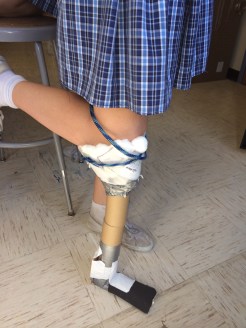
Our baseWe first started off brainstorming on the white board, then it came to executing our ideas, with the decision matrix. In the end, we decided to combine two ideas. We would use a sponge type of material for comfort, with a rounded solid piece to hold it. For the foot we would make it out of wood and then we would have a strap to attach to your upper leg.
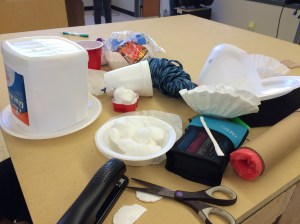
When we began working it was all going smoothly and we had our base. Which consisted of a two very durable cardboard pipe like material, that was attached by a pool noodle inside. We left a gap in the middle so the knee area wasn’t stiff. When we got to the strap and attaching it part, we struggled to come up with ideas. We were looking on google and found that a lot of prosthetics had almost like a sleeve that the upper leg could slide into and then attach. We really liked that idea but had no idea how to execute it. We found one of those huge Elmer’s glue container

Prosthetics Materialss and thought we could possibly make something out of that. Through a lot of cleaning, cutting, and stapling, we were able to mold it to our upper leg and then secure it to our base.We also added cotton balls for comfort and support. Now, for the foot. We decided our best option was to go with wood, since that seemed the most durable material. We used the saw machine to cut out our template and then wrapped it in felt and usProsthetic Side Viewed duct tape to attach it on.As you can see, we ran into a lot of problems throughout our building process, but I learned that sometimes that’s a god thing, because better ideas can come from your mistakes.
Biomedical Sciences

One of the modules that we’ve done is about bio-medical sciences. Our task was to brainstorm ideas for medicine in 50 or 100 years. Then put it all on a poster and make it interactive by using the Aurasma app. The Aurasma app works by programming it to focus on one of the drawings then once it recognizes it, a visual pops up and interacts with the drawing. Our group came up with some great ideas on how advanced medicine will become in 50 years. Some of our ideas were a cancer vaccine that you would take regularly instead of going through chemotherapy and anti-scar gel that you would put on a fresh wound or old wound that would heal faster without a scar instead of the anti-scar stuff they have now that you have to put on regularly and for a very long time regardless if the wound is old or not.


Bio-medical science expands in many different ways. There are things such as Stimulation Applications in Medicine, and Prosthetics. So biomed could expand as far as engineering and computer technology. In Simulations its basically like a computer simulation about how the stomach and other parts of the body react to certain types of medicine.


Our biomed project dealt with simple dynamics of epidemics. I learned a lot about prosthetics and how medicine is improving. We made a guess of what medicine will look like in the future. I learned about how the infectious rate changes the susceptible and infected rate. This module was really helpful to me and I learned so much.

-Jazlyn, Lilly and Emi

Reflections

One thing we do at the end of every module is write a reflecting. I used to not like to do this part, I thought it was time consuming and didn’t really see a point. For me, it was just another assignment that I needed to complete and didn’t give it much thought. I mean, we do reflections in other classes and they aren’t much different. Why should this one stand out?
When I was doing the reflection for our Intro to Engineering module, it finally clicked why we do these, or at least why I think we do them. We do them to realize all that we have learned, and reflect on that. Modules are very hands on, and at times can be very overwhelming. They can be stressful with lots of new knowledge coming from many different angles. Then, after two weeks, it’s over. You have a small rest period where you do the quiz and reflection, before the craziness repeats itself. The reflection is something I have come to appreciate. It helps slow everything down, and let it sink in. It helps some of the more important aspects of what you learned truly resonate with you. I like them because it lets you analyze all of the work you put in, and think about what you’ve done. Sometimes this can be positive, and sometimes it can be negative. You aren’t always happy with the outcome of your work. But it is always a learning experience. We can always think through what we did, and what we should change for the next time.
Each reflection has the same questions. The questions it asks are thought provoking, and always require a thoughtful answer. It asks things like: What was the big idea of this module? How did it make you feel? How did you contribute? And so on. They may seem simple, but after all the effort you have put into this project for the last weeks, they mean something different. You really have to think about what you did, especially if you were just going through the motions. It’s a time where you sit down and really think about these questions, and what they mean to you.
We do different modules every one or two weeks, so every time we do reflections we answer the questions in a way unique to fit it. Each time we answer the questions, we have a different perspective based off of our prior experiences. When we think about the main ideas especially, we have to go back and re-work what we’ve already done. It helps you understand what you have done and why we did it. It really helps you think of the module as a whole instead of individual challenges.
I think this effects our work in a positive way. It helps us know what we need to do next time to be more successful, and what makes our current modules successful. It helps us understand what we have learned, and cement our learning about many different subjects. I like reflections because they are a time to slow down and metacognate. They really help me understand my learning more!

-Georgia H.