By: Darby Buscemi
I would like to start this post off by letting you know that I love art. I’m not the best artist when it comes to drawing and painting but there are other types of art. I love photography and taking pictures. For me, it’s a way of expressing myself and I’ve been using a camera since I was three years old. So I was a bit reluctant to start the intro to photography module because the point of GTT is to introduce us to the other pathways. But I couldn’t help it. I had to because it’s one of the only things that I’m really passionate about. But since I have a lot of background knowledge on the subject, I was expecting the module to be super easy and to breeze right through it. I was wrong.
So first we, my partner and I, had to actually make the camera, which took at least half the week and caused a few burns from the hot glue gun. We had to make a box out of cardboard because we couldn’t find a box that was appropri ately sized and we didn’t want to make a cylindrical camera. So after the grueling and tedious task of making the camera, we painted the inside so it did not have any light coming through so it wouldn’t ruin the film. Light + photography paper = ruined photography paper. Then we had to cut a square hole in the camera for a lens. This hole was about 1/4 inch wide. Then we had to put a sheet of aluminum foil over the hole and make a small hole with a needle. This is the lens of the camera. We used a small piece of tape as the shutter so we could open it to take the picture but keep it closed while we were moving the camera.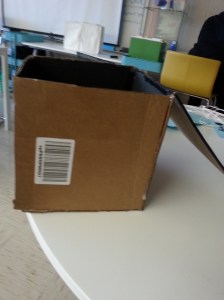
Next we had to learn how to load the film into the camera with help from our teacher, Ms. Sauter. We would take some photography paper and attach it to the opposite side of the lens, glossy side up, with double sided tape and closed the box and made sure the box was light tight. I would like to let you know that we were doing all this in the dark with only one red light bulb so it was extremely difficult to do this. So finally with the paper loaded we went outside to take the picture.
While outside, we put the camera on the ground so it would be steady because we’d have to have to shutter open a long time. Next we chose something to take a picture of. For our first test we just chose to take the picture of the wall. We opened the shutter and left it open for about two minutes. After the time was up we closed the shutter and brought the camera inside to develop the photo.
To develop the photo we took the camera back into the dark room and turned all the lights off so we could open up the camera. Using only the red light we took the photography paper out of the camera and placed it into the developer for about a minute until the picture has fully developed. Next we put the photo into the water to wash off the developer so we could turn on the lights. The picture turned out a little dark so we tried again but we left the shutter open longer. This time about four minutes. The picture turned out okay but some of the developer had washed up in the water so when we turned the light on the photo got ruined. So we tried one last time, again, leaving the shutter open for about four minutes but this time, after we put the photo in the water, we put it in something called fixer. The photo had to stay in the fixer for twenty minutes but it had turned out good.
Overall this was a really fun module that let me explore different aspects of photography and now I know how to develop a photo. I had a lot of fun and so far this module is my favorite.
 ARS Design Lab