Mechanism plays a big part in Engineer pathway. In the Makerspace, we love to design and create new things. Engineering is also like that, designing and building. It’s simple as that, but with mechanism, is not so simple as you think.
But first, let’s get to know mechanisms.
What is mechanism?
Mechanisms are the parts of a machine, which contains two are more pieces arranged so that the motion of one compels the motion of another. Change the type, direction, speed, and amount of torque of movement.
- Type of Movement
- Rotary
- Reciprocating
- Oscillating
- Linear
- Direction in Gears
- Meshed gears in a grain train always turn in opposite direction.
- The flow of power is reversible only if you can make the input shaft turn by the output shaft.
- Speed (Show by Gear Ratios)
- If the output gear is larger than the input gear the speed will decrease.
- If the output gear is smaller than the input gear the speed will increase.
- Torque
- A push or pull in a circular direction.
- If the output gear is larger than the input gear the torque will increase.
- If the output gear is smaller than the input gear the torque will decrease.
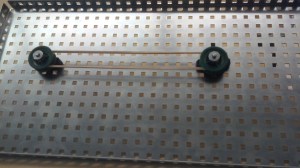
The ideas seem simple, but when you actually try to imply this into The Vex Robotic Kits, it’s hard. These are some things that we can build using these tools. A Simple gear train, bevel gear, differential gear, worm and wheel, lead screw, rack and pinion, universal joint, chain drive, belt drive, crank and slider, crank and follower. Below is an example of a belt drive. I built it for my first challenge in this mechanism module. I was frustrated at first, because I didn’t know what to use, but eventually I got the hang of it.
Building A 3 Skewers Rotary
The goal of this challenge is to turn three separate skewers over a flame at one time using mechanism. We planned to use the simple gear train with idler, to complete this task. But first we need to have the materials.
Materials you will need…

Spiky screws

Screws
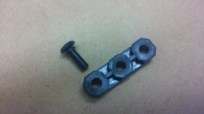
Universal Joints

Metal Pallets
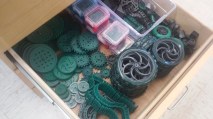
Gears

Metal Sticks
Screws, universal joint, metal pallets, gears, and metal sticks.
First, we connected the metal pallets with the universal joints and spiky screws, to build and basic foundation.




Second, you’ll put the gear into the metal stick and the metal pallet. Make sure to leave some space to put in screws and a spacer. Note that you need one input so put a handle into one of the gear, that will be your driven. The last gear will be your drive. When the gears on the pallet, be sure that the the gear are not overlapping nor too far apart. They have to be just right, touching each other.
Lastly, make sure to put all the screws to where it supposes to be BEFORE you screwing it in.
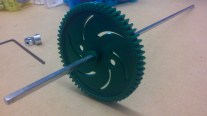
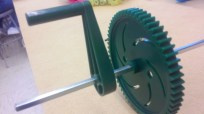

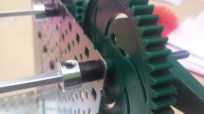
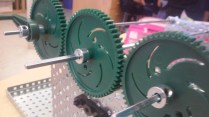


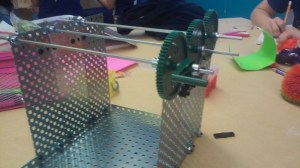
You notice that all the gears are equal to each other, so the gear ratio will be 1:1. This mechanism doesn’t increase the amount of torque not speed. The only thing that it does is the motion of rotary on all three skewers. Here is a short video on how it function.
 ARS Design Lab